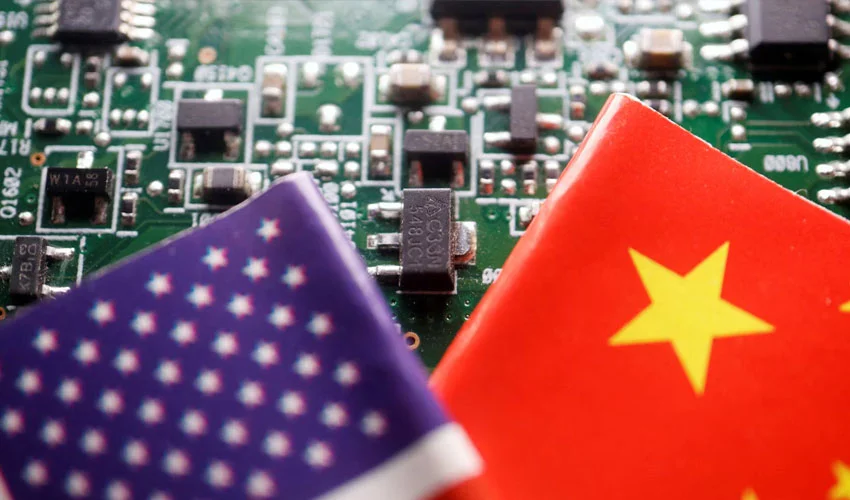
President Donald Trump announced plans to impose a 100% tariff on semiconductor chips imported from countries that don’t manufacture in the United States or haven’t committed to doing so — a move expected to escalate trade tensions and benefit U.S.-based production.
In a bid to accelerate onshore chip production, President Trump told reporters on Wednesday that all semiconductor imports not tied to U.S. manufacturing will face a new 100% tariff.
“The rule is simple,” Trump said in the Oval Office. “If you don’t build in America or commit to building here, your chips will be taxed — heavily.”
While Trump did not specify a start date or countries impacted, the proposed tariff is widely viewed as part of his broader strategy to cut reliance on China and strengthen domestic supply chains, especially in critical sectors like AI and defense.
Who’s affected – and who’s not?
The impact of the proposed tariff would vary widely depending on the country and company. Taiwan’s TSMC, the world’s largest chipmaker and supplier to firms like Nvidia, already operates in the U.S., shielding its customers from penalties.
Nvidia, a leader in AI chip technology, has committed to investing hundreds of billions into U.S.-based production over the next four years, positioning itself to avoid any new levies. The company declined to comment on Trump’s remarks.
However, Chinese chipmakers such as SMIC and Huawei would likely face the full brunt of the tariff, especially since much of their hardware is assembled in China before reaching the U.S. market.
“Survival of the biggest” as pressure mounts
Analysts suggest that large, cash-rich tech firms will have the upper hand in adapting to Trump’s tariff policy.
“Companies that can afford to build in America will benefit the most. It’s survival of the biggest,” said Brian Jacobsen, chief economist at Annex Wealth Management.
The comments echo Trump’s consistent stance on reviving American manufacturing, especially in critical infrastructure.
Global reaction and trade deal implications
Trump’s tariff threat comes amid ongoing trade negotiations with China, with Washington looking to curb the entry of sensitive technology tied to national security concerns.
Other key chip-producing nations such as South Korea, Japan, and the European Union appear to have secured favorable positions. All three regions have either existing trade agreements or mutual tariff understandings with the U.S.
The EU confirmed it had negotiated a 15% flat tariff on most exports, including chips, while South Korea and Japan say they were promised no worse rates than other major partners — implying exemption from Trump’s 100% tariff proposal.
Background: america’s push for chip independence
In 2022, Congress approved $52.7 billion in subsidies for semiconductor manufacturing and research under the CHIPS Act. Since then, the U.S. has convinced all five leading-edge chipmakers to commit to building factories on American soil.
The Commerce Department noted that U.S. chip production had declined from 40% of the global market in 1990 to just 12% in 2023 — a statistic Trump frequently cites when advocating for his economic policies.
Senior economist Martin Chorzempa from the Peterson Institute said the tariff’s real impact depends on how it’s enforced.
“If the tariffs are not applied to components within assembled products, it may not change much,” he explained. “But if they include devices with Chinese chips, the shift could be significant.”