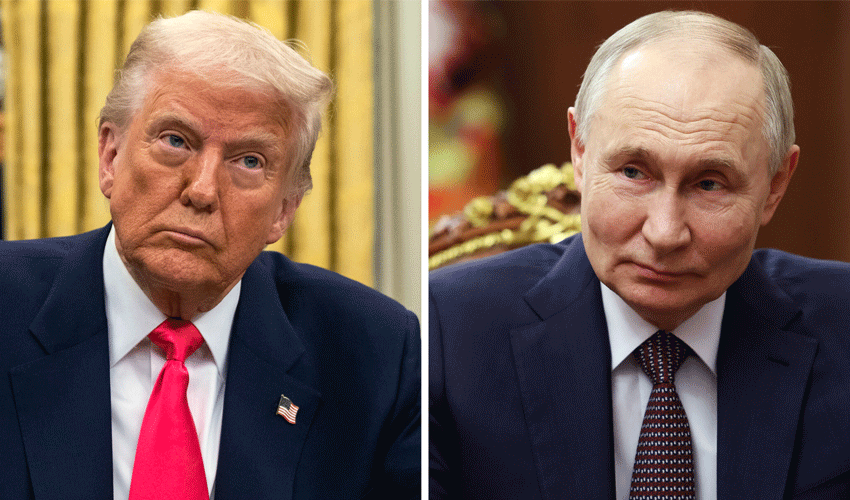
United States President Donald Trump has ordered the repositioning of two nuclear submarines in what appears to be a pointed response to recent warnings issued by former Russian president Dmitry Medvedev.
In a post shared on his social media platform, Truth Social, on Friday, President Trump said the movement of the submarines was intended as a deterrent against “highly provocative statements” made by Medvedev earlier this week.
“I have ordered two Nuclear Submarines to be positioned in the appropriate regions, just in case these foolish and inflammatory statements are more than just that,” the post read.
The statement comes days after Medvedev, currently serving as the deputy chairman of Russia’s Security Council, invoked the Cold War-era Soviet automatic nuclear weapons control system — known as the “Dead Hand” — in a veiled threat aimed at the US president.
“Words are very important, and can often lead to unintended consequences,” President Trump added. “I hope this will not be one of those instances.”
The development marks a significant escalation in what has become a protracted and increasingly hostile exchange between the two political figures, as tensions over the ongoing conflict in Ukraine continue to mount.
Growing tensions
The current spat began earlier this month, when Trump criticised Medvedev over remarks he described as “sabre-rattling”. The Russian official had cautioned the US about underestimating Moscow’s military resolve, particularly in the context of nuclear deterrence.
“Trump’s playing the ultimatum game with Russia,” Medvedev wrote on X (formerly Twitter), earlier this week. “He should remember two things: Russia isn’t Israel or even Iran. Each new ultimatum is a threat and a step towards war — not between Russia and Ukraine, but with his own country.”
Trump, for his part, has used increasingly strong language in recent weeks, accusing Medvedev of attempting to provoke conflict and threatening further economic sanctions on Russia if its military offensive in Ukraine does not cease.
In remarks made on July 28, President Trump warned that Russia had “10 or 12 days” to halt its operations or face sweeping economic penalties. The Kremlin has so far dismissed those warnings, with Medvedev describing them as “theatrical”.
Cooling relations with Moscow
Trump, who entered his second term in office promising to act as a global peacemaker, had previously taken a conciliatory tone with Russian President Vladimir Putin. He notably told Ukrainian President Volodymyr Zelenskyy in an Oval Office meeting that “Putin went through a hell of a lot with me”.
However, that tone has shifted in recent months, with Trump publicly expressing frustration over what he described as “disgusting” Russian military actions.
“Russia — I think it’s disgusting what they’re doing,” Trump said on Thursday, shortly after reports emerged of fresh Russian shelling in Kyiv.
Trump’s efforts to act as a mediator in the conflict have drawn criticism, particularly following past remarks in which he referred to President Zelenskyy as a “dictator” and hinted at possible territorial concessions to Moscow.
Nuclear rhetoric raises alarms
The latest exchange of threats has alarmed observers, with analysts warning that the public posturing between Trump and Medvedev risks further inflaming an already volatile geopolitical environment.
Medvedev’s reference to the “Dead Hand” — a semi-automated Soviet-era system designed to retaliate with nuclear strikes in the event of a decapitation attack on Moscow — was widely interpreted as an implicit warning of Russia’s nuclear capabilities.
While there is no indication that either side is preparing for direct military confrontation, Trump’s decision to reposition nuclear assets is likely to draw international scrutiny.
At the time of filing this report, neither the US Department of Defense nor Russia’s Ministry of Defence had issued formal statements confirming the movement of naval assets.
Analysts suggest the move may be symbolic, aimed at reaffirming American deterrence in the face of renewed Russian assertiveness.
Background
Medvedev served as Russia’s president between 2008 and 2012, with Vladimir Putin acting as his prime minister. The two later reversed roles, with Medvedev assuming the post of prime minister until 2020. He is widely seen as a close ally of President Putin and has been one of the most vocal proponents of Moscow’s military campaign in Ukraine.
The war in Ukraine, which began with Russia’s full-scale invasion in February 2022, has entered its third year with no clear end in sight. Multiple efforts at peace negotiations have stalled, and Western powers continue to support Kyiv through military and financial aid.