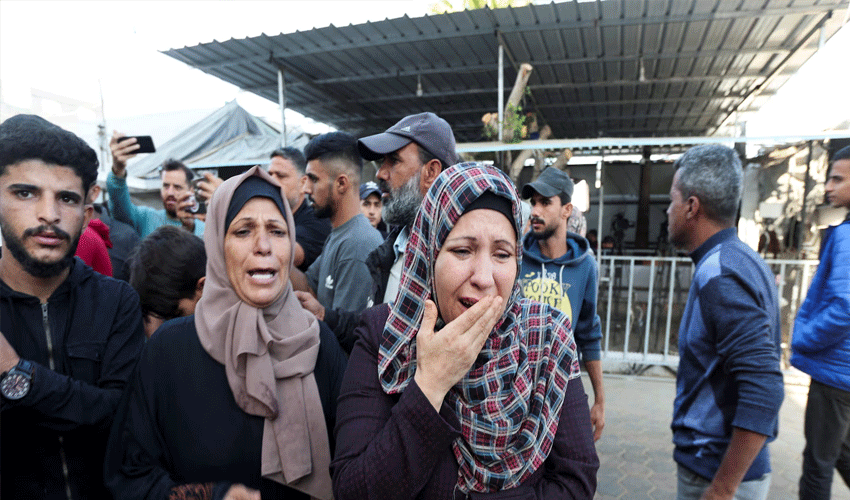
At least 95 Palestinians were killed in Israeli strikes on Sunday, including an attack on a crowded Gaza City market and a water collection site in Nuseirat refugee camp, as the death toll in Israel’s military offensive surpassed 58,000, according to the Palestinian Ministry of Health.
Seventeen people, including a prominent physician, Dr Ahmed Qandil, were killed in the market bombing, while a separate missile attack on a water point in central Gaza’s Nuseirat area left at least 10 people dead — seven of whom were children, local medical officials reported. The children were reportedly lining up to collect drinking water when the strike occurred. Another 17 individuals were injured.
The Israeli military acknowledged the Nuseirat attack but claimed it was targeting a Palestinian fighter and the missile veered off course due to a technical malfunction. It has not commented on the Gaza City market bombing. The claim of malfunction has not been independently verified.
Jessica Dorsey, an international law expert at Utrecht University in the Netherlands, questioned Israel’s explanation, citing a repeated pattern of civilian casualties in Gaza.
“Mistakes do happen in war,” Dorsey said in remarks to Al Jazeera. “But with the advanced capabilities Israel possesses, one would expect greater precision, not repeated civilian harm. It raises questions about whether these incidents are part of a broader modus operandi.”
Humanitarian crisis deepens
According to the latest figures provided by the Gaza Health Ministry, the total death toll since the war began on October 7, 2023, now stands at 58,026. More than half of those killed have been women and children. At least 138,500 people have sustained injuries, while Gaza’s population of 2.1 million continues to face dire shortages of food, medicine, clean water, and electricity under the ongoing Israeli siege.
The humanitarian situation has worsened to the point where several UN agencies, including UNICEF, the World Food Programme (WFP), and the World Health Organization (WHO), warned on Sunday that a critical fuel shortage may soon bring all aid operations to a halt.
In a joint statement, eight UN bodies expressed grave concern: “Fuel must be allowed into Gaza in sufficient quantities and consistently to sustain life-saving operations. Without it, there will be no health services, no clean water, and no capacity to deliver aid.”
The agencies stressed that hospitals, ambulances, water desalination plants, and sewage systems are already on the verge of shutdown.
Surge in child malnutrition
UNICEF highlighted that at least 5,800 children were diagnosed with malnutrition in June alone — over 1,000 of them in severe condition. “Children’s bodies are wasting away. This is not just a nutrition crisis. It’s a child survival emergency,” the agency said on X (formerly Twitter).
On Sunday, UNRWA confirmed the death of a seven-month-old girl named Salam from malnutrition — the latest in a growing toll of children reportedly dying from hunger-related causes in Gaza. Local authorities estimate at least 67 children have died from malnutrition since the beginning of the war.
Accusations of ‘intentional targeting’
Gaza’s Government Media Office accused Israeli forces and foreign contractors of deliberately attacking civilians at aid distribution sites. The office condemned the US-backed Gaza Humanitarian Foundation (GHF) centres as “death traps,” claiming they are part of “genocide engineering under US sponsorship.”
At least 805 people have reportedly been killed and more than 5,200 injured while attempting to access aid since the GHF began operating in May.
Ceasefire talks falter
The new wave of violence comes as ceasefire negotiations remain stalled. Mediators have expressed concern over the intensifying humanitarian crisis, warning that continued fuel shortages and civilian deaths may derail any progress toward a resolution.
While international calls for a ceasefire continue, both Israel and Hamas have shown little sign of compromise in recent weeks. Meanwhile, humanitarian agencies warn that without immediate action, Gaza could face “a total collapse of civilian infrastructure.”