The U.S. Federal Aviation Administration (FAA) and Boeing have privately informed global aviation regulators that the fuel cutoff switch locking mechanism on Boeing aircraft, including the Dreamliner 787, is safe and does not require urgent modifications.
In a notification dated July 11 and seen by Reuters, the FAA stated that although the fuel control switch locking design is common across various Boeing aircraft models, it does not consider the mechanism to be an “unsafe condition” warranting an airworthiness directive.
The move comes in the wake of a preliminary report by India’s Aircraft Accident Investigation Bureau (AAIB), which revealed that both engines of the Air India Boeing 787 shut down moments after takeoff when the fuel switches were found flipped to “cutoff.”
“The FAA does not consider this issue to be an unsafe condition that would warrant an Airworthiness Directive on any Boeing airplane models, including the Model 787,” read the notification addressed to global Civil Aviation Authorities.
Boeing echoed this stance in a multi-operator message (MOM) sent to airline customers shortly afterward, with two sources confirming that the American planemaker is also not recommending any further action at this time. When approached for comment, Boeing referred all questions back to the FAA, while the FAA declined to elaborate beyond the contents of its notice.
The AAIB’s preliminary findings cited the unexplained flipping of fuel cutoff switches just seconds after takeoff from Ahmedabad on June 12, leading to the engines being starved of fuel mid-climb. Voice recordings from the cockpit captured one pilot asking, “Why did you do the cut-off?”, to which the other replied, “I didn’t.”
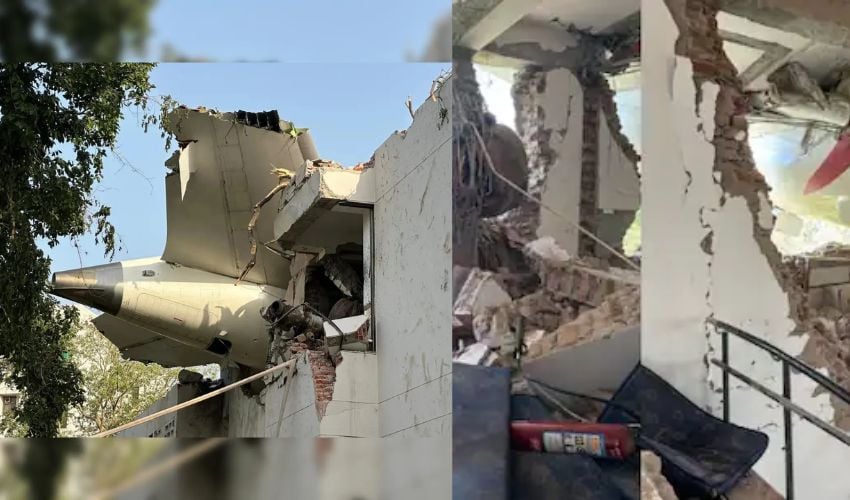
The crash, which killed 242 passengers and crew on board and 18 others on the ground, has triggered renewed scrutiny over cockpit protocols, mechanical safeguards, and the overall safety standards in India’s booming aviation sector. It is considered the deadliest civil aviation disaster globally in over a decade.
Old advisory resurfaces in probe
The AAIB’s report also referenced a 2018 FAA Special Airworthiness Information Bulletin (SAIB), which recommended — but did not mandate — that operators of several Boeing models, including the 787, inspect the locking feature of their fuel cutoff switches to ensure they could not be inadvertently engaged.
However, Air India had reportedly not performed these voluntary checks. The airline clarified in the report that because the 2018 bulletin was advisory in nature and not a regulatory requirement, it was not incorporated into their maintenance schedule. Still, records show that the throttle control module, which houses the fuel switches, had been replaced twice — in 2019 and 2023 — on the ill-fated aircraft.
The AAIB report noted that all relevant airworthiness directives and service bulletins had been complied with by Air India at the time of the crash.
Pilots’ union pushes back against error assumptions
In a sharp response, ALPA India — which represents Indian pilots at the International Federation of Air Line Pilots’ Associations (IFALPA) — rejected any premature assumption of pilot error and urged for a “fair, fact-based inquiry.”
“The pilots body must now be made part of the probe, at least as observers,”
— Capt. Sam Thomas, President of ALPA India
The union has expressed concern that the report’s mention of the 2018 advisory implies a potential equipment malfunction, and in a formal letter posted to X (formerly Twitter), it said the switch design should be investigated further.
Two U.S.-based aviation safety experts echoed the call for transparency, with one former ALPA U.S. representative, John Cox, noting that while the AAIB report does not suggest bias, pilot representatives should be allowed to observe the investigation process.
“The report appeared to be objective and fair,”
— John Cox, Aviation Safety Expert
Ongoing investigation, no final answers
Despite the report’s findings and technical confirmations from both the FAA and Boeing, crucial questions remain unanswered — chiefly, how both fuel switches were flipped from “RUN” to “CUTOFF” in such a short span of time.
The report underscored that the switches require a two-step manual action and cannot be moved easily or accidentally. Experts say it’s highly unusual, if not implausible, for both switches to be disengaged mid-flight unless there was intent or a significant system malfunction.
Adding to the uncertainty, the switches were found back in the “RUN” position at the crash site, suggesting an attempted engine relight — but the aircraft, at a low altitude, had insufficient time to recover.
The final report into the crash is expected within the year, per international aviation norms. In the meantime, India’s Civil Aviation Ministry and Air India continue to face mounting questions about procedural compliance, pilot training, and broader safety culture within the country’s expanding aviation sector.