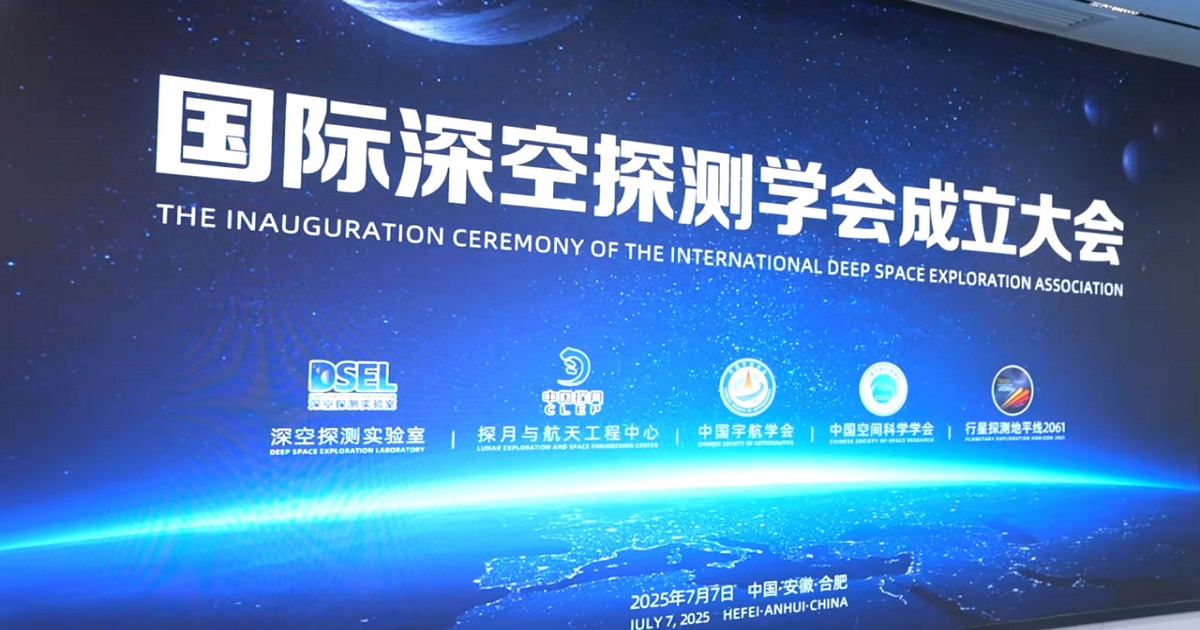
China has on Monday launched the International Deep Space Exploration Association (IDSEA) with an aim to empower other developing countries in deep-space technologies.
Located in Hefei, east China’s Anhui Province, the association will be the nation’s first international academic organization in the aerospace domain, capitalizing on the growing global interest in China’s lunar and Mars missions.
“We strive to, within a decade, attract 500 international research members and 100,000 individual scientist members,” Wu Weiren, chief designer of China’s lunar exploration program and an academician of the Chinese Academy of Engineering, told CGTN.
The IDSEA will focus on deep-space study, which includes probes into the moon, other planets and asteroids, and promote international cooperation, according to the Hefei-based Deep Space Exploration Laboratory, one of the association’s five initiators.
Wang Zhongmin, director of the lab’s international cooperation center, said the IDSEA aims to become an inclusive academic platform that will benefit developing countries in particular.
“We hope to bring in as many developing countries as possible, and by initiating small yet impactful programs, such as on CubeSat design and training of scientists, we hope to enable these nations to access cutting-edge space technologies that once seemed far beyond their reach,” he said.
Deep-space exploration has long been limited to a few countries due to its high thresholds of capital, technologies and talents. “The vast majority of countries may see a technological monopoly. Deep space technologies must move out of the small circle to benefit the whole of humanity,” Wang said.
The association is expected to boost international space cooperation by bringing individual space agencies together, guests at the IDSEA’s launch ceremony told CGTN.
“Many countries are specialized in one thing… So it makes a lot of sense for everyone to collaborate with the rest of the world,” said Simone Dell’Agnello, a researcher at Italy’s National Institute for Nuclear Physics and a founding member of the IDSEA.
“With this association, we will be able to reach all the international partners and scientists in one platform, so they will be aware of the ongoing and future missions,” said Ahmet Hamdi Takan, an expert in Turkiye’s Deep Space Science and Technology, also a founding member.
Despite being a latecomer to outer space exploration, China has rapidly emerged as a prominent player in this field while demonstrating its commitment to cooperating with other nations.
In April, China announced that seven institutions from six countries – France, Germany, Japan, Pakistan, the United Kingdom and the United States – have been authorized to borrow lunar samples collected by China’s Chang’e-5 mission for scientific research.
China has also invited global partners to participate in its Mars missions. The country plans to launch the Tianwen-3 Mars sample-return mission around 2028, with the primary scientific goal of searching for signs of life on Mars. The retrieval of samples from Mars, the first of its kind in human history, is considered the most technically challenging space exploration mission since the Apollo program.