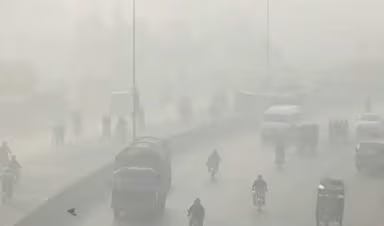
The City of Gardens is increasingly turning into a health hazard as air pollution continues to affect residents throughout the year, with toxic air no longer limited to the winter smog season.
Lahore has once again topped the list of the world’s most polluted cities, with its overall Air Quality Index (AQI) recorded at 390 and readings exceeding 800 in several parts of the city, raising serious concerns about public health.
Experts have advised residents to avoid unnecessary outdoor activities, wear masks and take precautionary measures as pollution levels remain dangerously high.
Air pollution in Lahore is not merely a seasonal problem that emerges during a few days of winter smog. The city’s air remains polluted throughout the year, although the intensity and concentration of pollutants change with weather conditions.
During summer, pollutants have more space to disperse into the atmosphere, while winter conditions cause smoke and toxic particles to become trapped in a relatively shallow layer of air, making pollution more concentrated near the ground.
The question of when Lahore’s air is actually clean has become increasingly difficult to answer, as pollution continues to pose risks even outside the traditional smog season.
Pollution layer shrinks as winter approaches
Research indicates that the height of the layer containing concentrated pollution over Lahore changes significantly throughout the year.
According to the findings cited in the report, the pollution layer reached around 860 metres in May and June. It stood at approximately 400 metres in October before shrinking to around 260 metres in November, with estimates suggesting it could fall further to just 190 metres in December.
As the polluted layer becomes shallower in winter, pollutants can remain concentrated closer to the ground, increasing exposure for residents.
Lahore’s annual pollution levels
The annual average concentration of fine particulate matter (PM2.5) in Lahore’s air has been recorded at 88.9 micrograms per cubic metre, approximately 18 times the World Health Organization’s recommended annual guideline of 5 micrograms per cubic metre.
These fine particles can penetrate deep into the respiratory system, making prolonged exposure a major public health concern.
According to a report by the Urban Unit, transport is the largest contributor to air pollution in Lahore, accounting for 83% of emissions. Industries contribute 9%, crop-residue burning accounts for 4%, while waste burning and various domestic and commercial activities contribute the remaining 3%.
The report highlights the need to address pollution from vehicles, industrial activity and other sources to improve the city’s air quality.
Clean air could increase life expectancy
Research suggests that if Lahore’s pollution levels were reduced to the standards recommended by the WHO, residents could potentially gain around 5.8 years in life expectancy.
The findings underline the long-term impact of air pollution on public health and the importance of sustained efforts to reduce exposure to toxic particles.
While government strategies, targets and policy plans remain important, the central concern for Lahore’s residents is when they will be able to breathe clean air.
Clean air is not simply a luxury or an environmental ambition; it is a fundamental necessity for life.
Peshawar also faces worsening air pollution
Air pollution has also intensified in Peshawar alongside the colder weather, with the city’s overall AQI exceeding 270, raising concerns about the health of residents, particularly children and the elderly.
Ring Road, GT Road, University Road and Kohat Road are among the most affected areas, where residents are facing difficulties due to deteriorating air quality.
Experts have advised people to wear masks when going outdoors and take precautionary measures to reduce exposure to polluted air.
Gujranwala AQI reaches 245 amid pollution
Gujranwala has also been grappling with environmental pollution for several days, with the city’s AQI reaching 245, a level considered unhealthy.
The worsening air quality has reportedly left several citizens falling ill, while factories operating in residential areas have been identified as a major source of pollution.
The pollution situation in Lahore, Peshawar and Gujranwala highlights the growing environmental and public health challenges facing urban centres in Punjab and Khyber Pakhtunkhwa, particularly as colder weather further intensifies air pollution.