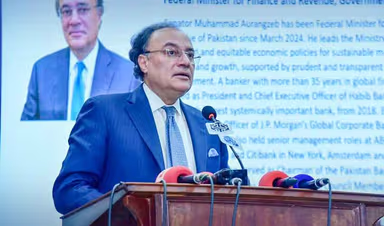
Finance Minister Muhammad Aurangzeb has said the government is pursuing the privatisation of 26 state-owned entities (SOEs) as part of its efforts to reform the public sector and improve economic efficiency.
Addressing the 29th Sustainable Development Conference organised by the Sustainable Development Policy Institute (SDPI) in Islamabad, he said right-sizing measures had already been implemented at several government institutions, while work on further reforms and privatisation was continuing.
Speaking on the second day of the conference, Aurangzeb explained that the Cabinet Committee on State-Owned Entities had worked on the government’s right-sizing agenda.
He said the process had led to restructuring and closure measures involving the Pakistan Agricultural Storage and Services Corporation (PASSCO), the Utility Stores Corporation and the Pakistan Public Works Department (PWD).
Aurangzeb said the government implemented its right-sizing decisions in phases, adding that some institutions had already been restructured or downsized.
“Unfortunately, in our country, efforts are often wasted,” the finance minister observed, highlighting the challenges involved in implementing long-delayed reforms.
Privatisation of 26 state-owned entities govt priority
Aurangzeb said the privatisation of 26 state-owned entities had been included among the government’s key priorities. He noted that these entities had been handed over to the Privatisation Commission as work continued on the government’s broader privatisation programme.
The finance minister also confirmed that the government was working on the privatisation of power distribution companies (DISCOs) and entities in the banking sector.
He said the reform process was ongoing and would require time, consistent effort and phased implementation.
Decades of reforms cannot happen overnight
The finance minister acknowledged that Pakistan faced a substantial reform challenge, arguing that long-standing structural problems could not be resolved within a short period.
“Reforms that could not be achieved in 78 years cannot be accomplished in just one to one-and-a-half years,” Aurangzeb said.
He also highlighted the value of recommendations prepared by former State Bank governor Dr Ishrat Husain, saying his report had proved highly useful to the Cabinet Committee on State-Owned Entities in developing its reform agenda.
SBP governor stresses inclusive economic growth
Speaking at the conference, State Bank of Pakistan Governor Jameel Ahmad praised Dr Ishrat Husain’s contribution to the country’s economic reform agenda. He said Husain had taken economic reforms in Pakistan to new heights, while stressing that the benefits of economic growth must reach every household.
Ahmad’s remarks highlighted the importance of ensuring that economic progress translates into improved living standards across the country.
The second day of the 29th Sustainable Development Conference brought together discussions on Pakistan’s economic reform agenda, including public-sector restructuring, privatisation and the need to make economic growth more inclusive.