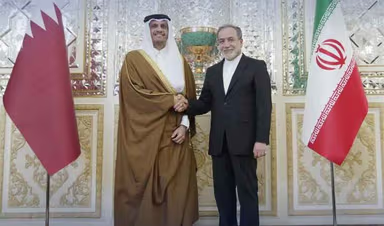
Diplomatic efforts to secure an agreement between Iran and the United States have intensified, with a Qatari delegation arriving in Tehran for the third time in a week as both sides explore ways to end the months-long conflict.
The delegation, led by an adviser to Qatar’s prime minister and foreign minister, held discussions with Iranian Foreign Minister Abbas Araghchi on Monday night, focusing on the latest draft of a potential US-Iran agreement.
According to Arab media reports, the latest Qatari visit is part of Doha’s intensified efforts to bring Washington and Tehran closer to an agreement and prevent a return to full-scale hostilities.
An Iranian source quoted by the Qatar-owned Al-Araby Al-Jadeed newspaper said the delegation was headed by an adviser to Qatar’s prime minister and foreign minister.
It was the third visit by Qatari mediators to Tehran within a week. The delegation had previously travelled to Iran on Sunday and returned again on Friday as part of ongoing consultations.
Following one round of intensive discussions lasting approximately 12 hours, the Qatari delegation departed Tehran alongside Iranian Deputy Foreign Minister Kazem Gharibabadi, who had also held related discussions in Doha.
Reuters separately reported that the Qatari mediators met Araghchi to discuss a version of the proposed US-Iran agreement that has been under negotiation for the past eight days.
An official briefed on the discussions confirmed that the latest draft was the main subject of the talks.
Proposed agreement focuses on reopening Strait of Hormuz
The agreement currently under discussion reportedly envisages the reopening of the Strait of Hormuz by Iran in exchange for sanctions relief from the United States.
According to a diplomat familiar with the negotiations who spoke to The Times of Israel, the proposed arrangement would be followed by comprehensive discussions on Iran’s nuclear programme.
The reported framework seeks to address the immediate maritime and economic crisis before moving towards broader negotiations over Tehran’s nuclear activities.
The Strait of Hormuz remains a critical global energy corridor, and its closure has disrupted international oil supplies and pushed energy prices sharply higher.
Araghchi confirms intensive indirect negotiations
Iranian Foreign Minister Abbas Araghchi confirmed on Monday that indirect negotiations with Washington were continuing through mediators.
Speaking in a video interview with Iran’s official IRNA news agency, Araghchi said consultations had become particularly intensive because of the seriousness of the situation.
“Given the sensitivity and gravity of the current situation, consultations and deliberations are very intensive,” he said.
He specifically acknowledged the mediation efforts of Qatar and Pakistan, saying both countries were playing an active role in facilitating negotiations between Tehran and Washington.
Qatar’s repeated diplomatic visits to Tehran and the involvement of Iranian officials in discussions in Doha reflect the continuing efforts to narrow differences between the two sides.
Trump, Vance express optimism over possible agreement
The latest diplomatic activity comes as US President Donald Trump has signalled progress in efforts to avoid a resumption of military confrontation with Iran.
Writing on his Truth Social platform on Monday, a day before the crucial US midterm elections, Trump said an agreement with Tehran “could happen”. He also claimed that Iran wanted to reach a settlement as soon as possible.
US Vice President JD Vance separately expressed optimism about the negotiations, saying both he and Trump were encouraged by the progress made so far.
“We’ve certainly made some progress. We’ll see if we can make some more,” Vance told reporters on Monday.
His remarks reinforced Washington’s position that diplomatic efforts were continuing, although the final outcome remained uncertain.
Oil prices fall amid hopes of breakthrough
Expectations of a possible agreement between Iran and the United States also triggered a sharp reaction in international energy markets.
Oil prices fell by more than seven per cent on Monday as investors responded to growing optimism that the conflict could end and the Strait of Hormuz could reopen.
Prices had surged following Iran’s blockade of the strategic waterway, which disrupted a major energy transportation route and intensified concerns over global oil supplies.
With Qatar continuing its mediation efforts and Pakistan also playing an active diplomatic role, the latest discussions have raised hopes of a breakthrough.
However, the proposed agreement remains under negotiation, and the coming days will be crucial in determining whether Tehran and Washington can bridge their differences and move towards a lasting settlement.