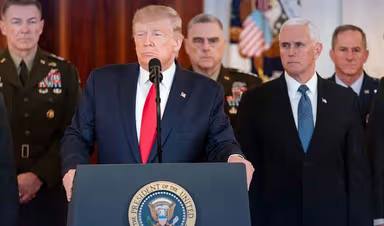
US President Donald Trump says Washington is weighing a deal with Tehran or renewed military action, as US forces prepare strike options and Pakistan-mediated efforts to reopen the Strait of Hormuz remain uncertain.
US President Donald Trump has ruled out a US strike on Iran for Monday, October 26, while leaving the door open to military action in the coming days as Washington weighs a new agreement with Tehran.
Speaking to reporters and in an interview with Fox News’ ‘Sunday Morning Futures’, Trump said the decision remained whether to reach an agreement with Iran or “finish the job.” His remarks come amid continued tensions over Iran’s nuclear programme, the US naval blockade and shipping through the Strait of Hormuz.
Asked whether the United States could attack Iran on Sunday, Trump said, “There will not be a strike today,” making clear that no immediate military action was planned. However, he did not rule out a strike at a later date.
“I have a decision to make: Do I finish it off, which would be very easy to do, or do I make a deal? That’s the decision,” Trump said during his Fox News interview.
He also told reporters that Washington was making progress regarding Iran and claimed that Tehran was not making significant advances at its nuclear facilities.
Trump said the United States was closely monitoring Iran’s nuclear infrastructure, including the Pickaxe Mountain site, and three other facilities that Washington has said were destroyed in previous strikes.
“There isn’t much activity going on there,” he said, adding that the US Space Force was monitoring Iran’s nuclear facilities and that Washington would know how to respond if suspicious activity occurred.
The US president claimed that thousands of tons of rock remained above Iran’s nuclear facilities, making it difficult for Tehran to restore its nuclear capabilities. He reiterated that Iran would never be allowed to acquire nuclear weapons and said the nuclear issue would be resolved soon.
Trump warns against nuclear-armed Iran
Trump has repeatedly described preventing Iran from obtaining a nuclear weapon as the central objective of US policy. He warned that a nuclear-armed Iran could create severe consequences for regional security and global energy supplies.
“You want to see problems? You want to see not only energy problems, but death problems? Let them have a nuclear weapon — because they would use it,” Trump said in a statement quoted by the White House-aligned Rapid Response 47 account.
In other remarks published by the White House, Trump said Iran would use a nuclear weapon immediately if it acquired one.
The president has also questioned whether Tehran would honour any future agreement, saying Iranian leaders want a deal but raising doubts about their willingness to abide by its terms.
“There’s a possibility I will,” Trump said when asked about another attack on Iran. “There’s also a possibility we’ll have a nice, big, beautiful agreement.”
He argued that ending the previous military campaign after US B-2 bomber strikes in 2025 could have allowed Iran to rebuild its nuclear capabilities and eventually develop a bomb.
“I’ve got to make it permanent. That’s the only reason I’m doing it as long as I’m doing,” he said.
US military prepares options for renewed strikes
Despite Trump’s statement that no strike would take place on Sunday, US forces in the Middle East are reportedly prepared to launch new military operations against Iran within 96 hours of receiving an order from the president, according to two US officials cited by CNN.
The officials said sufficient forces had been deployed to carry out potential attacks. The proposed operation could go beyond limited strikes against radar systems, missile launchers and other military assets that Iran could quickly rebuild.
“It will be a big effort,” one official told CNN.
US Central Command and the Pentagon have reportedly developed a broader list of potential targets, including Iranian energy infrastructure, military installations and nuclear facilities. However, officials cautioned that Trump has not made a final decision and has previously considered military action before backing away.
A senior Pentagon official said the department’s responsibility was to develop and execute military options ordered by the president.
Some current and former US officials believe an order could come before the end of the year, although they consider the period after the November 3 US midterm elections more likely.
The Hill also reported, citing two sources familiar with the planning, that the US military had prepared options for renewed strikes after the midterms. One source said US Central Command had follow-up strike plans ready for presidential authorisation, while another said several options were being presented to War Secretary Pete Hegseth.
The Wall Street Journal separately reported that US naval forces were preparing for possible renewed attacks, with sailors loading munitions and readying aircraft aboard American warships.
The preparations reportedly include the USS George Washington aircraft carrier strike group as Washington considers further action against Iran.
Trump receives differing intelligence assessments
Trump said on Sunday that he had received two very different sets of intelligence reports concerning Iran, some of which remained classified.
Asked about a declassified intelligence assessment warning of advanced Iranian plots, he said the United States had highly developed intelligence capabilities but declined to disclose details of the other assessment.
“We have very advanced sets of intelligence on Iran. Some has been declassified and some hasn’t,” Trump said, adding that Washington was “doing very well” in its dealings with Tehran.
Separately, an unclassified October 23 memorandum from Director of National Intelligence Jay Clayton to Secretary of State Marco Rubio said US intelligence had found that Iran had substantially increased efforts to target American personnel.
According to CNN, the memorandum also warned that plotting efforts had reached advanced stages in the Middle East and certain other countries.
Recent US intelligence assessments suggest Iran and Yemen’s Houthi rebels are taking the possibility of renewed American and Israeli attacks seriously. Sources familiar with the assessments said Tehran and the Houthis would likely retaliate against US personnel and facilities in the region if Iran were attacked first.
The sources assessed that Iran and the Houthis were unlikely to launch pre-emptive escalatory attacks at this stage but would not hesitate to respond to a new US or Israeli strike.
Israel pushes for renewed joint military action
Israeli Prime Minister Benjamin Netanyahu has been pressing Washington to support additional attacks on Iran, but US officials have reportedly asked Israel to wait until the Trump administration is ready for possible joint operations.
According to CNN, Netanyahu sought Trump’s approval for a joint attack before the US midterm elections, but the president did not give the green light.
An Israeli security source said Israel Defence Forces Chief of Staff Eyal Zamir had warned US General Dan Caine, chairman of the Joint Chiefs of Staff, that an attack could harm Israel’s elections and potentially lead to their postponement.
Another source briefed on the matter said Israel had been preparing for further strikes during the previous week and lobbying US officials to participate in or support the operation.
Senior US officials, including Trump, reportedly told Israel to hold off while signalling that joint operations could take place later.
Israel is understood to have delayed immediate plans partly because it needs American support for missile defence. Iranian and Houthi retaliation could place additional pressure on Israeli defences, whose interceptor supplies have been strained during the conflict.
US intelligence assessments have also reportedly questioned whether Netanyahu and his allies have a clear strategic objective beyond continuing to weaken Iran’s leadership and demonstrating progress.
Netanyahu said at an IDF graduation ceremony that his directive to the Israeli military, Mossad and other security agencies was to topple the Iranian regime.
“The plans are ready, waiting for Trump’s approval, could be after the midterms,” a source familiar with the matter told CNN.
Netanyahu also warned in a post on X that Israel faced what he described as a “real and tangible existential danger” from Iran, arguing that the window for the US and Israel to act was narrowing.
In a video shared from an Israeli anti-missile battery, he said the IDF was prepared for both defensive and offensive operations and threatened retaliation against Israel’s enemies.
Trump had earlier raised the prospect of another military campaign during a pre-midterm rally in Florida, saying the United States could carry out “another little Epic Fury.”
Pakistan-mediated talks remain uncertain
Diplomatic efforts to end the confrontation have continued alongside military preparations, with Pakistan playing a key role in facilitating communication between Washington and Tehran.
Iranian Ambassador to Pakistan Reza Amiri Moghadam said on Saturday that Tehran had conveyed through Pakistani mediators that it was prepared to reopen the Strait of Hormuz if Washington lifted its naval blockade of Iranian ports.
Speaking at a seminar in Islamabad, Moghadam said Iranian officials had communicated their position during visits to Tehran by Pakistan’s army chief, Field Marshal Asim Munir. He accused Trump of rejecting the proposal by insisting that the blockade would remain in place.
The ambassador said Iran remained open to negotiations under an interim agreement brokered in June with the assistance of Pakistan and Qatar. The framework envisaged restoring shipping through the Strait of Hormuz, lifting the blockade and starting negotiations on a broader agreement covering Iran’s nuclear programme.
Al Arabiya separately reported, citing unnamed sources, that Iran had informed Pakistan it was willing to resume negotiations with Washington and reopen the strait in exchange for the blockade being lifted.
However, Iran’s semi-official Tasnim news agency, which is affiliated with the Islamic Revolutionary Guard Corps, quoted an informed source rejecting Al Arabiya‘s report as “lies and fantasy.” The source said Tehran had made no new proposal to Pakistani mediators.
The source also said Iran did not accept any arrangement linking the reopening of the Strait of Hormuz to the lifting of the blockade. Tehran, the source added, would seek ways to circumvent the blockade and ultimately break it.
According to Tasnim, Iran continues to stand by seven conditions previously conveyed through mediators. The source said insecurity would persist until Iran’s demands were met, including an end to restrictions affecting its ports and shipping.
US blockade, Strait of Hormuz remain key pressure points
The US naval blockade of Iranian ports and the security of the Strait of Hormuz remain central to the confrontation. The waterway is a critical route for global oil and gas shipments, making any disruption a major concern for energy markets.
Trump claimed that more oil was currently passing through the strait than before the conflict, despite the US blockade. He also asserted that Washington controlled the waterway and that Iran was gaining nothing from the standoff.
US Central Command chief Admiral Brad Cooper visited the Strait of Hormuz on Sunday while American forces maintained the blockade and supported shipping traffic through the area.
CENTCOM said Cooper observed the operational environment from a helicopter and met service members involved in clearing Iranian mines from the waterway.
“We continue to stand shoulder to shoulder with our Gulf partners and the shipping industry,” Cooper said in a statement. He added that the visit underscored Washington’s commitment to freedom of navigation through the strait.
Despite an increase in tanker movements, oil prices have remained high partly because of the threat of potential Iranian attacks. One US official described the current situation around the waterway as “untenable” in the long term.
The official suggested that the absence of a diplomatic breakthrough was one reason Trump might eventually choose military action, while questions remained about the administration’s broader strategy for ending the conflict.
Trump has also predicted that oil prices would fall sharply once the conflict ends.
US reduces diplomatic, military personnel
Washington is reportedly preparing for the possibility of Iranian retaliation by reducing some of its personnel in the Middle East.
CNN reported that the US Embassy in Riyadh was the only American diplomatic facility in the region under an ordered departure at the time of its report, while further departures and staffing reductions were expected in the coming days.
Non-essential US military personnel scheduled to deploy to the Middle East as part of the next troop rotation have also reportedly been told they would no longer be sent to the region.
The moves reflect concerns that a renewed US or Israeli attack could trigger retaliation against American personnel and facilities across the Middle East, potentially widening the conflict.
Trump has not announced a final decision on whether to resume military operations or pursue an agreement with Iran. While he has ruled out an immediate strike, reports of military preparations and Israeli lobbying suggest that the possibility of a larger operation remains under consideration.
Diplomacy faces its own obstacles, with conflicting reports about Iran’s willingness to reopen the Strait of Hormuz and the conditions under which negotiations could resume.
For Pakistan, which has helped facilitate communication between Washington and Tehran, the challenge is to sustain diplomatic engagement amid mounting military pressure. The next steps will depend on whether the two sides can bridge their differences over the nuclear programme, sanctions, the naval blockade and freedom of navigation through the Strait of Hormuz.