

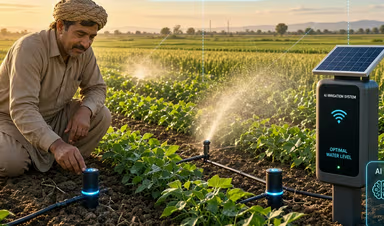
Pakistan’s AI debate is too narrow. Dawn’s editorial of 19 October made the case for sovereign AI capability and warned that a large part of the roughly $4.6bn in IT exports comes from freelancing, call centres and entry-level coding, work that automation reaches first. Both points are fair. But the larger question is where else AI can raise output across the economy, and the answer is agriculture.
Farming employs about a third of the workforce and accounts for nearly a quarter of GDP, yet its productivity is low and its main input, water, is scarce. According to the Pakistan Institute of Development Economics, wheat yields about 2.9 tonnes per hectare in Pakistan against 5.4 in China. Closing part of that gap would reach far more households than anything the IT sector can offer in the near term.
AI suits this problem because much of it is a problem of decisions. A farmer who does not know how much water a crop needs, or when, will usually err toward too much or too late. Soil sensors, local forecasts and crop data allow software to make that call field by field. The same logic extends to fertiliser and pesticide, which can be applied where the crop needs them instead of across the whole plot.
Early evidence points the same way, with limits. A pilot by the Sarhad Rural Support Program in Khyber Pakhtunkhwa links soil sensors to AI-controlled drip irrigation on solar power, and farmers are being invited to see it work. A media report from Rahim Yar Khan claims water savings of up to 30 percent from AI-aided drip systems. But the pilots are small, and that figure has not been independently verified. No independent comparison of water use, yield and cost per farmer appears to have been published. Until that exists, the case for AI in agriculture rests on plausibility, not proof.
That should shape how the government proceeds. Every publicly funded pilot should report water used, yield and cost per farmer against a comparable plot without the system, and publish the results. The requirement is modest, and it keeps the programme from being judged by its launch events.
The harder constraint is adoption. Most farmers work small holdings, and drip lines, sensors and solar pumps are expensive. Rural connectivity is uneven, and advice in English or through a data-heavy app will not reach many growers. A recent paper by researchers at the Islamabad Policy Research Institute reaches the same conclusion, calling for better digital connectivity and targeted subsidies. The technology is the easier part. The policy challenge is financing and delivery, and that is where government can make the difference.
That argues for working through institutions that already reach farmers: the provincial agriculture departments and the rural support programmes, backed by subsidies for smallholder equipment and by advice tools in Urdu and regional languages built on local weather and soil data. The expanded AI and skills training announced in Quetta through the Prime Minister’s Youth Programme should be tied to this effort, not run as a separate exercise.
That link also answers the concern about IT. About 64 percent of Pakistanis are under 30, and many who would have drifted into entry-level coding or call-centre work could instead be trained to install and maintain sensors, build local advisory software and support farmers. It puts the skills Pakistan has built in IT to work on a problem the country must solve regardless.
The same programme gives Pakistan something to bring to its diplomacy. It chairs the Shanghai Cooperation Organisation’s Council of Heads of State until the Islamabad summit in August 2027, and the prime minister’s priorities for the term include AI and digital transformation. Water-efficient farming is a concrete subject for that agenda and is relevant to many developing countries. Pakistan will be credible there only if it arrives with measured results from its own farms.
The measure of Pakistan’s AI strategy should therefore be simple: whether farmers use less water to grow more, and whether independent data show it. If they do, the country’s diplomatic positions will have a domestic return. If not, they will have produced statements and little else.