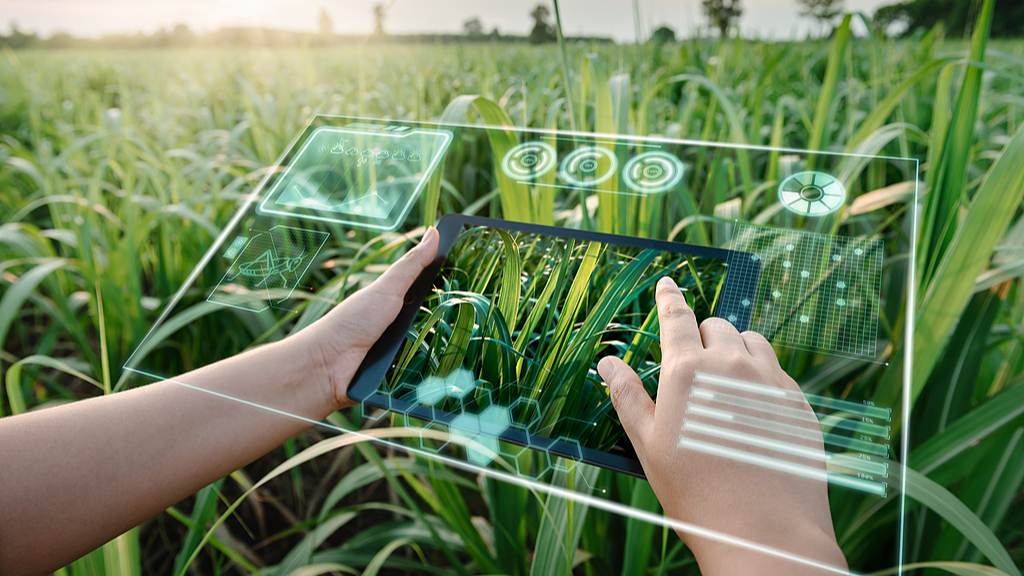
“Innovation Today, Food Security Tomorrow” is the theme for the 46th World Food Day, which takes place on Friday. As artificial intelligence (AI) moves from laboratories to fields, China’s agriculture sector is undergoing a shift from experience-driven to data-driven farming.
AI is accelerating advances in seed breeding. The “Shennong Guxin” intelligent breeding model developed by China Agricultural University integrates genotypic data with agricultural knowledge graphs, drawing on tens of millions of data entries. The model has shortened breeding cycles by more than 30%, reducing the time needed to develop new varieties from the conventional five to eight years to two to three years. Two new lettuce varieties developed using the model, Yanqi No. 1 and Yanqi No. 2, have been successfully trialed in Huairou District, Beijing, where they have shown strong stress resistance and good quality.
AI is also making field management more precise. This year, Longquan City in east China’s Zhejiang Province deployed intelligent pest-monitoring systems across about 733 hectares of early-season rice fields. Operating around the clock, the systems provide digital monitoring of crop pests and diseases. The initiative has reduced pesticide use by 20%, achieved pest-control effectiveness of more than 90% and kept crop losses caused by pests and diseases below 5%. Farmers can use pest alerts sent to their phones to guide drones in applying pesticides precisely to affected areas. According to the report, this means even people without farming experience can carry out targeted pesticide application.
Meanwhile, smart agricultural machinery is changing how farms are managed. Xinhua News Agency reported in June 2026 that central China’s Henan Province’s agricultural machinery cloud platform had connected more than 138,000 machines. At an unmanned farm in Qingfeng County, Beidou navigation enables driverless harvesters to cover more than 13 hectares in a day.
A July report by Science and Technology Daily described an unmanned ratoon-rice farm in Datong Lake, central China’s Hunan Province, where agricultural machinery guided by Beidou navigation operates alongside a digital management platform. Operating errors are kept within 2.5 centimeters. The 200-hectare rice farm requires only four people for management, while farmers’ net income can exceed 30,000 yuan per hectare. The project has been selected as an Food and Agriculture Organization of the United Nations Asia-Pacific model case for smart agriculture.
AI is redefining precision farming, but food security depends on more than technological progress. It also means ensuring that the people who cultivate the land can share in the benefits of innovation.