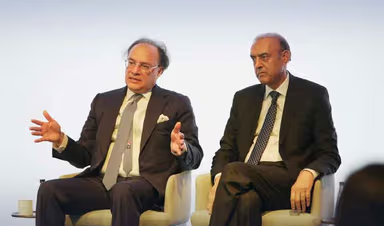
Finance Minister Muhammad Aurangzeb has held talks with International Monetary Fund (IMF) Managing Director Kristalina Georgieva on the country’s economic outlook and ongoing reforms on the sidelines of the IMF and World Bank annual meetings in Bangkok.
During his visit, Aurangzeb also addressed a J.P. Morgan investment seminar and spoke to NewsAsia about Pakistan’s economic priorities, remittances, debt management and plans to expand trade and investment ties with major global partners.
During his meeting with Georgieva, Aurangzeb briefed the IMF chief on developments in Pakistan’s economy and the recent staff-level agreement reached with the Fund.
The finance minister said reforms were underway across several sectors, particularly energy and taxation, as the government works to strengthen economic stability and address structural challenges.
Georgieva emphasized the need for Pakistan to continue its economic reform process, underscoring the importance of sustaining efforts to improve the country’s economic position.
Stability and fiscal discipline at J.P. Morgan seminar
Aurangzeb addressed a J.P. Morgan investment seminar in Bangkok titled ‘Pakistan: A Journey Toward Stability Amidst Uncertain Global Economic Conditions’.
He highlighted economic stability, fiscal discipline, revenue enhancement and the effective use of international financial resources as key priorities for Pakistan.
Discussions covered remittances, foreign exchange reserves, the current account deficit and external payments. The minister also outlined the government’s efforts to secure financial support without increasing the overall volume of external debt.
Aurangzeb explained that Pakistan was pursuing a strategy to replace high-cost debt with relatively lower-cost financial resources, while reiterating its commitment to implementing the IMF programme and advancing structural reforms.
He also stressed the importance of a prudent monetary policy to curb inflation, alongside a cautious approach to supporting deserving households and managing energy procurement.
The finance minister called for sustainable, export-led economic growth and highlighted the importance of fiscal coordination between the federal and provincial governments.
Participants also discussed improvements in economic management and ways to strengthen partnerships in trade and investment.
Pakistan shifting from aid to trade and investment
In an interview with NewsAsia, Aurangzeb said Pakistan was moving away from reliance on aid towards a development model built on trade, investment and stronger international partnerships.
He said the government was focused on strengthening global economic relationships and expanding cooperation with existing partners while exploring new markets and investment opportunities.
Pakistan received $41.6 billion in remittances during the last fiscal year, Aurangzeb noted. The figure is expected to rise to $44 billion in the current fiscal year, highlighting the continued importance of overseas Pakistanis to the country’s external finances.
The minister said relations with Gulf countries were particularly significant because of their contribution to both trade and remittance inflows. He added that Pakistan deeply valued the consistent support and cooperation extended by its international partners during difficult economic periods.
Pakistan seeks stronger ties with China, US
Aurangzeb said Pakistan intended to pursue stronger relations with China and the United States simultaneously, rather than treating closer engagement with one country as an alternative to ties with the other.
He described China as a long-standing partner and said the China-Pakistan Economic Corridor (CPEC) had been a key component of China’s Belt and Road Initiative.
According to the minister, the first phase of CPEC focused on developing infrastructure, including roads, ports and power plants. The second phase is aimed at generating greater economic benefits from that infrastructure and expanding business opportunities.
He said efforts were now underway to encourage collaboration and joint investment ventures between businesses in Pakistan and China. Certain joint ventures are already manufacturing products intended for export, he added.
Aurangzeb also stressed the importance of expanding economic ties with the United States. He said Pakistani leaders maintained good relations with the US administration and that these ties would be used to advance economic cooperation.
The minister noted that the United States was Pakistan’s largest trading partner, followed by the European Union. He said Pakistan intended to capitalize on the substantial potential for bilateral trade by increasing engagement with regional trade blocs.
New regional trade opportunities
Aurangzeb said Pakistan was further strengthening economic ties with Gulf countries, the United States, China and other long-standing partners.
With global trade becoming increasingly fragmented, he said cooperation between different regions was growing in importance. Pakistan was therefore exploring new avenues for collaboration with Gulf countries, Central Asian states and members of the Association of Southeast Asian Nations (ASEAN).
The minister said visits to Pakistan by the leadership of Malaysia and Indonesia had helped promote regional connectivity and cooperation.
He also said a meeting with Thailand’s finance minister would provide an opportunity to strengthen regional economic cooperation.
Despite challenges in the global economic environment, Aurangzeb said new trade opportunities were emerging. Pakistan aims to build on these opportunities by deepening commercial and economic relations with all bilateral partners, including Gulf nations, and expanding engagement with regional markets.
He reiterated that the country’s strategic direction was clear: to move from reliance on aid towards trade, investment and sustainable economic growth.