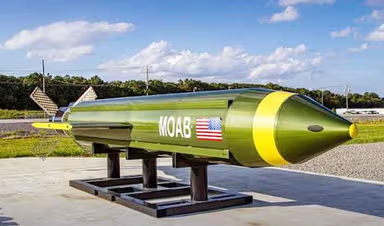
The potential use of the GBU-43/B Massive Ordnance Air Blast (MOAB), widely known as the “mother of all bombs”, would mark a significant escalation in the conflict. However, US officials have questioned whether the weapon could achieve Washington’s strategic objectives, particularly against deeply buried Iranian nuclear facilities.
Reuters said it could not immediately verify CNN’s report.
US develops new strike plans against Iran
According to CNN, citing multiple US officials familiar with military planning discussions, the Pentagon has prepared additional strike packages against Iranian targets that could be used if Trump decides to resume combat operations before or after the November midterm elections.
One source told CNN that Trump had ordered the military to develop options targeting “a lot of energy infrastructure”, including the potential deployment of the MOAB. The stated timing for such an operation was described as “prior to US retrograde in CENTCOM AOR”, suggesting the administration could launch additional strikes, attempt to declare victory and then withdraw US personnel from the region.
Another source said military plans for Iranian nuclear sites, including Pickaxe Mountain, explicitly include the possible use of the MOAB. The United States and Israel believe Tehran has stored components of its nuclear programme at the site.
Trump has repeatedly threatened to strike Pickaxe Mountain in recent months, even after pausing full combat operations earlier this year. He has continued to insist that preventing Iran from obtaining a nuclear weapon remains a central US objective.
Trump faces pressure to end war
The potential strike plans come as Trump faces pressure to bring the deeply unpopular war to an end, with Republicans concerned about a possible voter backlash in the upcoming midterm elections.
More than six months of US bombing have produced little indication that Washington and Tehran are close to a negotiated settlement. Although some administration figures have described the war as effectively won, Trump has been more cautious, stopping short of declaring victory and saying the United States still has unfinished business in Iran.
For months, Trump and his advisers have discussed options that could provide a “definitive” end to the conflict, at least in terms of public messaging. Officials are seeking a way for the president to present an outcome as a victory without closing the door to a diplomatic breakthrough.
Trump has also expressed doubts about suggestions from outside allies that the United States should simply withdraw its troops and move on, arguing that such a move would look like defeat.
Although Trump publicly announced that he would not take further military action before the midterms, several advisers privately told CNN they were unsure whether that pledge was final or could change before Election Day.
Questions over MOAB’s effectiveness
The GBU-43/B MOAB is the largest non-nuclear bomb in the US arsenal. Its potential use in the Iran conflict would represent a notable escalation, but military planning sources have questioned whether it could destroy facilities located deep underground.
A US official told CNN that the military develops a range of options for policymakers, from lower-intensity strikes to more powerful attacks. Targets buried deep underground generally require larger weapons, making the MOAB one option considered in planning discussions.
The GPS-guided bomb can devastate an area equivalent to about nine city blocks. However, sources said it is unlikely to penetrate deeply enough to destroy the suspected nuclear facilities at Pickaxe Mountain, which is believed to be protected by layers of granite, or other remaining Iranian nuclear sites.
One source familiar with the discussions described the MOAB as a weapon suited to large-area clearance rather than deep penetration. The bomb detonates before hitting the ground, projecting a powerful blast across the surrounding area.
If deployed, the weapon could cause devastating destruction at the surface without necessarily eliminating deeply buried targets. Its extensive blast radius would also raise serious concerns about civilian casualties, particularly if strikes hit infrastructure near populated areas or other non-military sites.
MOAB could be used for psychological impact
Despite questions about its ability to destroy underground nuclear facilities, the MOAB could offer Trump a way to increase pressure on Iran without immediately restarting full-scale combat operations.
A source familiar with recent military planning discussions told CNN that Trump may feel compelled to act and could turn to the weapon for its psychological impact, particularly because it is not designed as a deep-penetration bomb.
The same source suggested that the weapon could be used to alter the current situation even if it failed to force Iran to capitulate or deliver a decisive military victory.
US officials and outside analysts have argued that decisively defeating Iran militarily could require a major ground operation. Such an operation could cost thousands of American lives, although no one in the administration is currently advocating such drastic action, according to CNN.
Trump has indicated little interest in deploying US ground troops inside Iran. Nevertheless, his desire to end the conflict quickly has created a political dilemma: the war remains unpopular, but a diplomatic agreement to bring it to a close has not been secured.
Washington searches for exit strategy
For weeks, senior Trump administration officials and military planners have explored ways to give the president at least a symbolic victory that he could present to the American public while preserving the possibility of negotiations.
CNN has reported that one potential starting point for a diplomatic breakthrough would be an agreement to reopen the Strait of Hormuz, a critical waterway for global energy supplies.
A fourth source familiar with Pentagon planning described some of the proposed military options as a “fireworks show”, intended to provide Trump with an exit from the conflict even if the strikes failed to achieve the objectives originally cited to justify the war.
Meanwhile, the US military appears to be preparing for possible Iranian retaliation if Trump authorises further attacks, despite his recent pledge to hold off on new strikes before the midterm elections.
A fresh rotation of US troops deployed to the US Central Command (CENTCOM) region is also expected within the next few weeks. A US official told CNN that some personnel leaving the region might not be replaced by new service members.
White House and Pentagon respond
Asked about the potential strike plans, a White House official told CNN that the administration does not comment on sensitive military plans that may or may not exist.
The official added that Trump “keeps all options on the table” to ensure Iran never obtains a nuclear weapon.
A Pentagon official told CNN the Department of War plans for a broad range of operational scenarios to carry out presidential and secretary-level direction and ensure mission success in any operational environment.
The responses did not confirm whether Trump had approved the proposed MOAB deployment or ordered a specific strike against Iranian energy or nuclear facilities.
MOAB originally developed for psychological operations
Developed during the Iraq War, the MOAB is an air-blast weapon designed to detonate before impact, creating a massive explosion that spreads outward in multiple directions.
During the final stages of testing in 2003, military officials told CNN that the weapon had been conceived primarily for psychological operations. They hoped its enormous blast would frighten Iraqi troops, pressure them to surrender or discourage them from fighting.
The bomb was initially intended for use against large formations of troops and equipment, as well as hardened above-ground bunkers. Its potential target set was later expanded to include sites beneath softer surfaces, such as caves and tunnels.
Trump became the first US president to deploy the MOAB during his first term, authorising its use against Islamic State (ISIS) positions in Afghanistan in April 2017.
The strike targeted a network of fortified underground tunnels used by ISIS to stage attacks on Afghan government forces. Afghan officials reported that 36 ISIS fighters were killed, while US and Afghan officials said the blast destroyed three tunnels, along with weapons and ammunition. No civilian casualties were reported at the time.