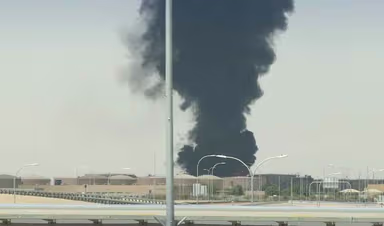
A fresh projectile strike hit a passenger terminal at King Khalid International Airport in Saudi Arabia’s capital on Sunday, killing one Pakistani national and injuring 11 others, according to the kingdom’s civil aviation authority.
The attack came a day after a devastating strike on the same airport killed 13 people and injured more than 300, making it one of the deadliest attacks on a Gulf Arab country since the US-Israel war against Iran began in February.
The escalating attacks have raised concerns about the security of Saudi Arabia’s airports, oil infrastructure and regional shipping routes, while increasing the possibility of direct US military involvement in the conflict.
Pakistani killed in second Riyadh airport attack
Saudi Arabia’s General Authority of Civil Aviation (GACA) confirmed late on Sunday that the person killed in the latest attack was a Pakistani resident. The 11 injured people were taken to hospital for treatment, while authorities continued assessing the material damage caused by the strike.
The Saudi-led coalition fighting the Houthis in Yemen said an unidentified projectile struck Terminal 4 at King Khalid International Airport, triggering a fire. Saudi air defences also intercepted a cruise missile near the airport.
The latest incident was part of a series of attacks on Saudi aviation facilities, with Riyadh’s airport reportedly struck four times within five days. The airport has remained closed since Saturday’s deadly attack, while authorities have extended precautionary measures.
Saudi Civil Defense also issued emergency alerts in Abha, in the kingdom’s south, early Monday, later confirming that the danger had passed.
Saturday’s missile attack killed 13 people
Saturday’s strike on Riyadh airport killed 13 people and wounded more than 300, according to updated reports from Saudi authorities. The attack was the deadliest on a Gulf Arab country since the regional war involving the United States, Israel and Iran began.
The victims included four Saudi nationals, two Bangladeshi nationals, and one citizen each from the United States, Jordan, Palestine, Syria, Sudan and Egypt. An Indian man later died from injuries sustained in the attack, bringing the reported death toll to 13.
The Egyptian victim was identified as Azza Ramzy, a 28-year-old flight attendant employed by Saudi airline Flynas, according to Egyptian state-run television.
Another victim, 56-year-old Syrian national Buthaina Ahmad Oweida, was a widowed mother of four who had lived in Saudi Arabia for five years. Her niece, Nisreen Oweida, told the Associated Press that Oweida had fled Syria’s civil war and was living in Makkah. She was returning from a visit to her sister in Riyadh when she was killed.
The Indian embassy in Saudi Arabia confirmed the death of its citizen on Sunday. US Secretary of State Marco Rubio also condemned the attacks and confirmed that an American citizen had been killed, while British Foreign Secretary Ed Miliband said he was “appalled”.
Saudi state television released security-camera footage showing pilgrims, many dressed in white robes for their journeys to Islam’s holiest sites, waiting inside a busy airport hall. A bright flash was followed by a fireball, sending passengers running for safety as parts of the terminal roof appeared to cave in.
Videos circulating on social media also showed travellers moving through debris-strewn areas as sirens sounded.
The Saudi-led coalition described Saturday’s attack as a “war crime” and vowed a firm response. Its spokesperson, Major General Turki al-Maliki, said the coalition would respond decisively but provided few details about its plans.
Houthis claim attacks on Dammam airport, oil facilities
Yemen’s Iran-aligned Houthi rebels claimed responsibility for Saturday’s attack and several other strikes against Saudi targets.
In a televised address on Sunday, Houthi military spokesperson Yahya Saree said the group had targeted Riyadh airport, King Fahd International Airport in Dammam and two facilities belonging to Saudi oil giant Saudi Aramco.
The Houthis said they had used a combination of ballistic missiles, cruise missiles and drones in operations against Saudi Arabia over the previous 24 hours. Saree vowed to continue what he described as escalating military operations deep inside the kingdom.
The Saudi government’s media office and Aramco did not immediately respond to requests for comment.
Saudi authorities separately confirmed that King Fahd International Airport in Dammam, in the Eastern Province, had come under attack. The General Authority of Civil Aviation said damage assessments and safety inspections were underway in coordination with relevant authorities.
An eyewitness aboard a taxiing aircraft at Dammam airport told Reuters that a projectile struck the tarmac near several parked aircraft at around 8:30pm on Sunday, causing a fire. The aircraft returned to the gate, passengers disembarked and were instructed to leave.
Flight-tracking website Flightradar24 showed multiple delays and cancellations involving arrivals and departures at Dammam airport, Saudi Arabia’s third-largest airport.
The Saudi-led coalition also reported intercepting and destroying a drone in the Eastern Province. A ballistic missile launched towards Khamis Mushait was intercepted, according to the coalition.
Meanwhile, the Houthis claimed that Saudi airstrikes had hit Sana’a International Airport, the airport serving Yemen’s rebel-held capital, on Sunday. Houthi-run Al-Masirah television subsequently reported additional strikes on the city.
The Houthi-run health ministry said a Saudi airstrike on a residential home in Sana’a killed a child and injured six others. Saudi Arabia has not confirmed the reported strikes, and the claims could not be independently verified.
Houthis warn airlines to avoid Saudi airports
The Houthis renewed their warning to airlines, passengers and aviation personnel against using Saudi airports and airspace.
“We urge everyone to take our warnings seriously, and Saudi Arabia bears responsibility for any failed interceptions,” the group said.
In a separate statement carried by Al-Masirah television, the Houthi-run foreign ministry warned that “worse is yet to come” if Saudi Arabia continued its military campaign and interference in Yemen.
The group said Saudi airports and airspace had become potential targets for its forces, while identifying the airports in the holy cities of Makkah and Medina as exceptions to its latest threat.
The warnings have prompted concerns about commercial aviation across the kingdom. Some airlines have suspended flights serving Saudi airports, while several foreign missions have issued travel advisories.
Britain’s embassy in Saudi Arabia advised British citizens against all but essential travel to Jeddah, Dammam and airports across the kingdom, with Medina’s airport excluded from the warning cited in its advisory.
The UK Foreign Office has also advised against travel to parts of Saudi Arabia, including areas within 10 kilometres of the border with Yemen. US aviation authorities issued a notice urging American airlines to exercise caution when flying to or over Saudi Arabia.
Other Western embassies have warned their nationals about the risks of travelling in the region.
Trump weighs direct US military involvement
The latest attacks have raised the prospect of the United States becoming directly involved in Saudi Arabia’s military campaign against the Houthis.
US President Donald Trump said on Saturday that Washington was considering joining the Saudi strikes. Asked about the possibility of military action, Trump said the administration would “make a decision” and move quickly.
Trump also said he planned to speak with Saudi Crown Prince Mohammed bin Salman following the airport attack. There was no immediate indication on Sunday that the planned conversation had taken place, and the White House did not issue a comment on the latest developments.
The United States has so far supported Saudi Arabia through intelligence cooperation and targeting assistance, with approximately 200 US military advisers stationed in the kingdom to assist the campaign. However, Washington had not directly participated in fighting the Houthis before the latest escalation.
Direct US intervention could prompt the Houthis to resume attacks on commercial shipping through the Bab al-Mandab Strait, a strategically important waterway at the southern entrance to the Red Sea through which around 10% of global maritime goods transit.
The Houthis seized key areas along the strait last month, while Saudi-backed Yemeni government forces have been attempting to regain control.
Any disruption to shipping through Bab al-Mandab could further restrict the movement of oil and other goods from the Persian Gulf, compounding the disruption already associated with the wider US-Iran conflict and threats to the Strait of Hormuz.
The latest violence has also increased pressure on Washington as the American public grows increasingly frustrated with the continuing war and rising domestic prices ahead of the November midterm elections.
Saudi Arabia steps up military campaign in Yemen
Saudi Arabia has recently intensified its military involvement in Yemen, launching airstrikes against the Houthis and backing a counteroffensive by forces loyal to Yemen’s internationally recognised government.
The latest escalation followed a Houthi offensive to capture strategically important stretches of Yemen’s Red Sea coast in early September. The campaign disrupted years of relative calm after a United Nations-brokered ceasefire in 2022 froze the frontlines between the rebels and government forces.
The ceasefire subsequently collapsed in July, and fighting intensified as the Houthis expanded their territorial gains.
Saudi-backed government forces launched a campaign to push the rebels out of areas seized during their recent offensive. Although government forces initially reported successes, the Houthis have maintained their hold over strategically important areas near Bab al-Mandab, including Perim Island.
The Houthis control approximately a quarter of Yemen’s territory and as much as 80% of its population. The group seeks to expand its control across the country, while Saudi Arabia fears that a complete Houthi takeover could establish an Iranian-aligned state along its southern border.
According to Yemen’s Houthi-run health ministry, Saudi-led coalition airstrikes over the previous five to six weeks killed 91 Yemenis and injured 168. The ministry said women and children accounted for around 60% of the casualties. These figures have not been independently verified.
The rebels have also cited Saudi military support for Yemen’s government and the reported airstrikes on Sana’a as reasons for targeting the kingdom.
Saudi Arabia seeks international assistance
The growing intensity of Houthi attacks has exposed concerns about Saudi Arabia’s air defence capacity, particularly its ability to intercept repeated missile and drone attacks.
Regional officials previously told the Associated Press that Saudi Arabia had asked France, Britain, Pakistan and Egypt to provide additional air defence support as its stocks of interceptor missiles dwindled. One official also noted that the United States had experienced a decline in its own interceptor supplies during the war with Iran.
On Monday, Saudi Arabia, Pakistan and Türkiye issued a joint statement saying they would move quickly to implement their mutual defence agreement, including by accelerating the deployment of military forces in the kingdom.
The United Kingdom also said it would provide defensive military support to Riyadh, including aerial refuelling for aircraft involved in intercepting Houthi missiles.
Saudi Arabia has sought additional assistance from France, Egypt, Britain and Pakistan as attacks on airports, oil infrastructure and military facilities continue.
Yemen’s internationally recognised government has also called for a stronger international response. Abdullah Al-Alimi Bawazir, vice-president of the government, urged regional and international partners to take decisive action.
Iranian Foreign Minister Abbas Araghchi, meanwhile, said in a Telegram post that he had told his Saudi counterpart that Tehran was ready to help facilitate dialogue between Saudi Arabia and Yemen, referring to the Houthi administration.
Saudi Arabia maintains international conference
The attacks occurred as Riyadh hosted a major international energy gathering, raising concerns about the security of the kingdom’s economic and commercial activities.
A five-day conference organised by WPC Energy opened as planned on Sunday at a convention centre approximately 10 kilometres from Riyadh airport. A ministerial meeting of the International Energy Forum also went ahead, according to the Saudi energy ministry, although it was unclear which ministers attended in person.
Italy’s energy minister, Gilberto Pichetto Fratin, had said on Friday that he would participate remotely by video link.
German officials were also attempting to arrange a return flight for Economy Minister Katherina Reiche, who was scheduled to leave Riyadh for Berlin on Monday. Germany’s economy ministry said it appeared likely that her flight would be unable to take off.
Speaking at the energy conference, Saudi Energy Minister Prince Abdulaziz bin Salman Al Saud sought to reassure attendees about the kingdom’s resilience.
“There is no way that somebody will break our back. We are like a phoenix, we come out of the ashes all the time,” he said.
The minister also said Saudi Arabia was working on additional oil pipelines beyond the East-West pipeline, which was attacked and temporarily shut down for several days last month. He did not provide further details.
The attacks have heightened concerns over global oil supplies and prices, which were already under pressure because of the US-Iran war. Houthi strikes against Saudi energy infrastructure could further disrupt regional energy exports and international markets.
Schools move online
Saudi authorities announced that in-person classes at schools in Riyadh would move to remote learning from Sunday through Thursday as a precaution following the attacks.
The airport strikes prompted international condemnation, including from United Nations Secretary-General António Guterres and European Commission President Ursula von der Leyen.
“Attacks by Iran’s proxies are pushing the region into a spiral of violence,” von der Leyen wrote on X, warning that the attacks were destabilising crucial global transport and energy infrastructure.
US Secretary of State Marco Rubio also condemned the strikes, while British Foreign Secretary Ed Miliband expressed shock at the civilian casualties.
The attacks have intensified fears that the conflict in Yemen could become more deeply intertwined with the wider regional war involving the United States, Israel and Iran, which has already spread to Lebanon and Iraq.
With Saudi Arabia intensifying its campaign, the Houthis threatening further attacks and Washington weighing direct military involvement, the latest strikes have placed regional aviation, energy supplies and maritime trade under renewed pressure.