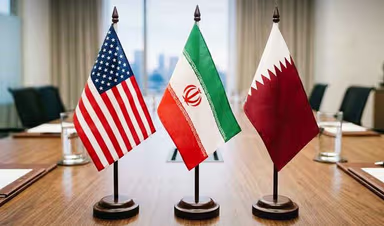
Diplomatic efforts to break the US-Iran deadlock have stalled, with Qatari mediation failing to produce a breakthrough and both sides holding firmly to their positions. The impasse is raising concerns that military operations could resume if negotiations continue to fail.
Qatari officials have spent the week trying to broker a diplomatic breakthrough between Washington and Tehran, but three sources familiar with the discussions told Axios that there has been little tangible progress.
Qatar’s efforts are continuing, although two sources said its officials are becoming increasingly frustrated with both sides. The stalemate has also strengthened concerns that the United States and Iran could eventually return to military confrontation.
US officials cited by Axios believe President Donald Trump could consider ordering a return to major combat operations after the November midterm elections if diplomatic efforts fail.
Qatari mediator Ali al-Thawadi met Iranian Foreign Minister Abbas Araghchi and his team in New York on Monday for several hours. The discussions included a two-page Qatari compromise proposal aimed at addressing the main demands of both sides.
Iran seeks end to naval blockade, nuclear concessions
According to sources cited by Axios, the Qatari proposal sought to bridge Iran’s demand for an end to the US naval blockade with Washington’s demand for concrete concessions on Tehran’s nuclear programme.
Iran has also sought a return to the terms of the June memorandum of understanding, while the United States has maintained that any agreement must address concerns over Iran’s nuclear activities.
Earlier, US officials had described the discussions as “positive and constructive” and said Iran had indicated flexibility on nuclear issues. Those officials also said Trump was willing to consider sanctions relief and the release of frozen Iranian funds in exchange for concrete steps to limit Iran’s nuclear programme.
However, Trump later said on Truth Social that reports that he had offered Iran sanctions relief were untrue, adding another complication to the diplomatic effort.
No significant movement in talks
One source familiar with Monday’s discussions told Axios that the negotiations remained stuck because Iran was demanding measures Washington could not accept, while the US believed its position was strengthening and therefore saw less need for compromise.
Regional mediators, including Pakistan and Egypt, have also urged Iran to accept nuclear concessions. Tehran, however, said it would consider such concessions only after Washington agrees to return to the June memorandum of understanding, according to a source cited in the report.
The US and Iran remain divided over the sequence of any potential agreement, including which side should take the first steps. Earlier US statements indicated that Washington wanted assurances that Tehran would implement concrete nuclear commitments.
Iranian security chief accuses Trump of being trapped
Iran’s Secretary of the Supreme National Security Council, Mohsen Rezaei, said Tehran had conveyed its conditions to Washington but claimed Trump was unable to make a decision.
“Trump is trapped in a quagmire in which he can neither negotiate nor fight,” Rezaei said, according to Iranian media reports.
He also said the United States had been informed of Iran’s conditions but suggested Trump was not in a position to make a decision. Rezaei characterized the US blockade as an alternative being pursued after Washington had failed to achieve its objectives through military action.
Trump says Iran in dire situation
Trump, meanwhile, said Iran was doing very poorly but acknowledged that he did not know whether Tehran was ready to “give up yet.”
“They will give up,” Trump told reporters, adding that the US objective was to prevent Iran from obtaining a nuclear weapon.
The comments came as the diplomatic track remained uncertain and tensions continued around the Strait of Hormuz, a central issue in the negotiations.
Iran has previously proposed reopening the strategic waterway and restarting nuclear talks in exchange for the lifting of the US naval blockade, sanctions affecting oil sales and a broader ceasefire. Trump has rejected Iran’s latest proposal, although he has indicated that further talks could take place.
Risk of renewed military action grows
With Qatar’s latest mediation effort failing to produce a significant shift, concerns over renewed US-Iran military action have intensified.
Qatari mediators are expected to continue shuttle diplomacy between the two sides, but the fundamental disputes over the Strait of Hormuz, sanctions, the naval blockade and Iran’s nuclear programme remain unresolved.
For now, the diplomatic channel remains open, but neither Washington nor Tehran has shown enough flexibility to overcome the latest impasse.