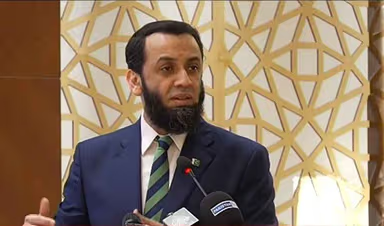
Federal Minister for Information and Broadcasting Attaullah Tarar has called for a long-term and sustainable solution to the complex situation in Afghanistan, urging the Afghan interim government to move beyond what he described as a militant mindset and adopt the outlook of a responsible state.
Addressing a ceremony in Islamabad, Tarar said Pakistan believed in peace, dialogue and peaceful coexistence, while stressing that lasting peace in Afghanistan could create new opportunities for trade, investment and regional connectivity.
Tarar said Pakistan had dispatched numerous high-level delegations to Afghanistan in an effort to resolve the Afghan issue through dialogue.
He said talks on Afghanistan had also been held in Istanbul and Doha, underscoring Pakistan’s support for dialogue aimed at reaching an acceptable and amicable solution.
According to Tarar, the Afghan interim government must move beyond a militant mindset and focus on the welfare of its people. He said many of the problems facing Afghanistan stemmed from such a mindset and that a shift was essential for sustainable peace.
Afghanistan has major trade potential
The information minister highlighted what he described as immense potential for increasing trade and regional connectivity through Afghanistan.
He said peace in Afghanistan could help open trade routes connecting Central Asia with Pakistan, while Central Asian states could gain access to warm waters through Afghan territory.
Tarar said access to trade routes reaching Karachi and Gwadar had been a long-standing aspiration of Central Asian states. He added that there was a widespread desire across the region for peace and greater trade.
Regional peace, he said, would strengthen trade and investment prospects and contribute to stability and development beyond Afghanistan’s borders.
Concerns over militant safe havens
Tarar said the presence of safe havens for terrorists and members of proscribed organisations in Afghanistan remained a cause for concern.
He stressed that peaceful coexistence required adopting the principle of “live and let live”, while reiterating that Pakistan wanted peace but that its desire for peace should not be mistaken for weakness.
The minister said attempts to destabilise Pakistan had been and would continue to be responded to firmly.
Tarar also drew attention to Afghanistan’s demographic and social challenges, noting that the Afghan population included a large number of young people.
He said a significant number of Afghan women were not part of the workforce, while certain sections of the population lacked opportunities to contribute to economic development.
The minister further said some sections of the Afghan public were being deprived of basic rights. He argued that Afghan people deserved fundamental rights, including education, freedom of assembly, freedom of association and economic liberty.
Afghan people should have say in their future
Tarar said there was a significant gap between the Afghan people and the interim government and stressed that the people should have a voice and a say in decisions concerning their future. He said the Afghan interim government needed to move beyond a militant outlook and work for the welfare of the Afghan population.
According to Tarar, a consensus must ultimately be reached in Afghanistan to give its people the right to choose their own future. He said the Afghan people deserved a better and prosperous future and that peace alone could provide the foundation for lasting prosperity.
Peace could benefit the wider region
Tarar said peace in Afghanistan could enhance prospects for stability and development across the entire region. He linked regional stability with stronger trade and investment and said improved connectivity could benefit Afghanistan, Pakistan and the Central Asian states.
The minister reiterated that Pakistan supported dialogue and peaceful coexistence and wanted an acceptable and amicable resolution to the Afghan issue.
He said the objective should be a sustainable peace that benefits the Afghan people while opening greater opportunities for regional cooperation, trade and economic development.