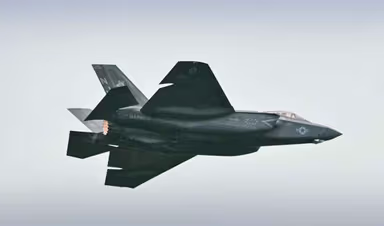
The United States has approved the potential sale of 48 F-35 Lightning II fighter jets to Saudi Arabia in a proposed deal worth $24.3 billion, marking a significant development in Washington’s defence relationship with Riyadh.
Announced by the US State Department on Thursday, the deal comes as Saudi Arabia faces escalating attacks by Iran-aligned Houthi forces and seeks to strengthen its air-defence capabilities. The proposal must still clear congressional review and has raised concerns among some US lawmakers and defence officials.
The US State Department said the potential Foreign Military Sale would include 48 Lockheed Martin F-35 Lightning II aircraft and 49 Pratt & Whitney F135-PW-100 engines, comprising 48 installed engines and one spare.
The estimated $24.3 billion package would also cover a wide range of equipment and support services, including:
- Secure communications and precision-navigation equipment.
- Cryptographic systems and electronic-warfare support.
- Spare parts, training systems and flight simulators.
- Software, technical documentation and logistics services.
The principal contractors involved in the proposed sale would be Lockheed Martin Aeronautics, based in Fort Worth, Texas, and Pratt & Whitney Military Engines, based in East Hartford, Connecticut.
The State Department said it was not aware of any proposed offset agreement linked to the deal. Any such arrangement would be negotiated separately between Saudi Arabia and the contractors.
The department said the proposed sale would strengthen Saudi Arabia’s ability to deter current and future threats, improve homeland defence and enhance interoperability with US, regional and NATO forces.
It would also expand the Kingdom’s operational aircraft fleet and improve its air-to-air and air-to-ground self-defence capabilities.
Sale won’t affect regional military balance
The State Department said the proposed sale would support US foreign policy and national security objectives by improving the security of a major non-NATO ally that contributes to political stability and economic progress in the Gulf region.
The department also maintained that the transfer of the aircraft would not alter the military balance in the Middle East and would have no adverse impact on US defence readiness.
The proposed sale nevertheless represents a potentially significant shift in Washington’s approach to supplying advanced fighter aircraft to Saudi Arabia.
Under longstanding US policy, Israel is guaranteed a “qualitative military edge” over potential regional adversaries. This means Washington must assess major weapons sales to regional countries to ensure that Israel retains access to more advanced US military capabilities.
The F-35 sale could therefore prompt renewed debate over how the United States balances its strategic partnership with Saudi Arabia with its security commitments to Israel.
Saudi Arabia seeks advanced fighter jets
The proposed F-35 sale comes as Saudi Arabia faces heightened security threats from Iran and Iranian-backed Houthi forces in Yemen.
On Wednesday, the Houthis claimed that they had shot down a Saudi F-15 fighter jet over Marib, a key city in Yemen’s conflict between the Iran-aligned group and Saudi-backed government forces. The Houthis released footage showing fighters standing in front of burning wreckage that appeared to be a US-made F-15 bearing Saudi markings.
The group claimed it had used a “locally made” surface-to-air missile to bring down the aircraft. If confirmed, such an incident could represent a significant development in the Houthis’ air-defence capabilities.
Saudi Arabia has so far enjoyed relative air superiority in Yemen and has relied heavily on airstrikes against Houthi positions.
Meanwhile, intensifying fighting between Saudi Arabia and the Houthis reportedly killed at least five people, including three children, on Thursday.
Saudi Arabia has also unsuccessfully sought a more direct US military role in its confrontation with the Houthis. Washington has said it will not directly intervene in the conflict involving the Iran-backed group, Saudi Arabia and the Saudi-backed Yemeni government.
F-35 sale could reshape Saudi Arabia’s air force
Saudi Arabia has pursued F-35 fighter jets for years as part of efforts to modernise its air force and strengthen its ability to counter regional threats, particularly those posed by Iran.
The Kingdom’s latest request for 48 aircraft would amount to two squadrons. The proposed acquisition comes as the Trump administration signals a willingness to deepen defence cooperation with Riyadh.
Saudi Arabia currently operates a mixed fleet of fighter aircraft, including Boeing F-15s and European-made Panavia Tornados and Eurofighter Typhoons.
The F-35A would introduce fifth-generation stealth capabilities to the Royal Saudi Air Force, offering advanced sensors, information fusion, secure communications and reduced detectability by enemy radar.
The F-35 Lightning II is a multirole fighter aircraft developed around stealth technology and advanced electronic systems. The United States produces three principal variants: the F-35A, which uses conventional takeoff and landing; the F-35B, which is capable of short takeoffs and vertical landings; and the carrier-based F-35C.
Saudi Arabia has requested the F-35A variant.
Israel’s military edge remains key concern
The proposed transfer has renewed questions about Washington’s longstanding commitment to maintaining Israel’s qualitative military edge in the Middle East.
Israel has operated the F-35 for about a decade and has built multiple squadrons. It is currently the only Middle Eastern country operating the aircraft.
If the Saudi purchase is completed, Riyadh would become the first Arab country to operate the F-35 and the second country in the Middle East to acquire the aircraft. The proposed fleet of 48 jets would bring Saudi Arabia close to Israel’s existing fleet of approximately 50 aircraft.
Israel’s Foreign Ministry announced in May that the country planned to acquire another F-35 squadron. That purchase is expected to double Israel’s fleet to 100 aircraft, according to the Jerusalem Post.
Israeli officials have previously expressed concerns about selling the advanced fighter to Saudi Arabia, even as Washington has encouraged Riyadh to normalise relations with Israel.
Türkiye, a NATO member that participated in the multinational development of the F-35, has been excluded from receiving the aircraft since 2019 after purchasing a Russian S-400 air-defence system. The decision reflected US concerns about the security of sensitive F-35 technology.
Concerns over Chinese access
Potential Chinese access to sensitive American military technology has emerged as another major obstacle to the proposed sale.
The New York Times reported that US intelligence analysts had raised concerns that Beijing could obtain F-35 technology through its growing security and military partnerships with Saudi Arabia.
Some US lawmakers have opposed the deal on national security grounds.
Representative Raja Krishnamoorthi, a Democratic member of the House Intelligence Committee, warned that the sale could expose some of America’s most sensitive defence technology to China.
“It could put the crown jewels of American military technology within reach of the Chinese Communist Party,” Krishnamoorthi said in a statement.
Other Democratic lawmakers and US defence officials have expressed similar concerns, arguing that Riyadh’s expanding relationship with Beijing could create risks surrounding the protection of the aircraft’s technology and operational capabilities.
The United Arab Emirates previously suspended a proposed $23 billion F-35 purchase in December 2021 amid concerns during the Biden administration over Abu Dhabi’s relationship with China and its use of Huawei’s 5G technology.
Saudi Arabia welcomes proposed fighter jet sale
The Saudi Embassy in Washington welcomed the proposed F-35 deal, describing it as another step in the longstanding strategic partnership between Saudi Arabia and the United States.
“The proposed F-35 sale reflects the strength and enduring nature of the Saudi-US strategic partnership and the continued advancement of our defense cooperation,” the embassy said in a post on X.
“For decades, Saudi-US security cooperation has contributed to regional stability, strengthened our collective defense capabilities, and advanced our shared security interests,” it added.
Saudi Arabia is pursuing an ambitious programme of economic and military modernisation under Crown Prince Mohammed bin Salman’s Vision 2030 agenda.
The Kingdom has also sought to diversify its defence partnerships while maintaining its decades-long security relationship with Washington.
F-35 purchase linked to broader diplomatic efforts
Saudi Arabia’s pursuit of the F-35 has been closely linked to wider US diplomatic initiatives in the Middle East.
The administration of former US President Joe Biden previously explored the possibility of supplying the aircraft to Saudi Arabia as part of a broader agreement that would have included the normalisation of diplomatic relations between Riyadh and Israel.
Those diplomatic efforts ultimately stalled.
President Donald Trump has made arms sales to Saudi Arabia a priority since returning to office. In 2025, the United States agreed to an arms package worth nearly $142 billion for the Kingdom, which the White House described as the largest defence cooperation agreement in US history.
Trump has maintained close ties with Saudi leaders, including Crown Prince Mohammed bin Salman, who visited the White House last November. The two leaders also met in Riyadh in May 2025, where the major arms agreement was announced.
Trump’s son-in-law, Jared Kushner, has also maintained business ties with Saudi Arabia. The Kingdom’s sovereign wealth fund invested $2 billion in his private equity firm between the Trump administrations.
Congress to review proposed $24.3bn deal
Although the State Department has approved the potential Foreign Military Sale, the agreement is not yet final.
The proposal has been formally submitted for congressional review, and lawmakers have 30 days to scrutinise the transaction or attempt to block it under the US arms-sales process.
Congressional opposition could create challenges for the deal, particularly given concerns about technology security and Saudi Arabia’s previous human rights record.
US lawmakers previously scrutinised arms agreements with Riyadh following the 2018 murder of Saudi journalist Jamal Khashoggi. Some members of Congress remain cautious about expanding military cooperation with the Kingdom.
The State Department’s approval does not mean that the aircraft have been delivered or that a final purchase contract has been signed. If the transaction proceeds, production and delivery of the jets would take several years.
F-35 programme expands across allied countries
The F-35 Lightning II is a fifth-generation multirole fighter designed around stealth, advanced sensors, information fusion and secure communications.
According to Lockheed Martin, 20 countries participate in the F-35 programme, with more than 1,355 aircraft delivered and over one million flight hours recorded.
The participating countries include the United States, Britain, Italy, the Netherlands, Canada, Australia, Denmark, Norway, Israel, Japan, South Korea, Belgium, Poland, Singapore, Finland, Switzerland, Germany, the Czech Republic, Greece and Romania.
Israel is currently the only Middle Eastern operator of the aircraft. Japan, South Korea and Australia are among its major operators in the Indo-Pacific, while several European NATO members have also introduced the fighter.
The F-35’s advanced stealth and sensor capabilities have made it a key component of the air forces operating it.
Saudi defence ties diversify amid regional tensions
The proposed sale comes as Saudi Arabia faces renewed military pressure from Iran-aligned forces and seeks to strengthen its defence partnerships.
Riyadh signed the Makkah Joint Defence Agreement with Pakistan and Türkiye last month, reflecting efforts by the three countries to develop mutual-defence arrangements amid evolving regional security dynamics.
The agreement also comes against the backdrop of Saudi Arabia’s longstanding military dependence on Washington and its efforts to diversify its international defence relationships.
Saudi Crown Prince Mohammed bin Salman has reportedly pressed President Trump to take direct military action against the Houthis. However, according to sources familiar with the matter, the US president has so far declined to involve American forces directly in the Saudi-Houthi conflict.
The potential F-35 acquisition therefore represents not only a major military modernisation project for Saudi Arabia but also a significant development in the Kingdom’s long-term strategic relationship with the United States.