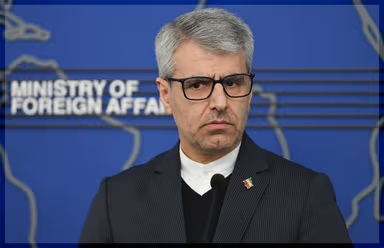
Iran said Monday that Saudi Arabia had requested the postponement of a planned meeting in Oman involving Tehran and foreign ministers from Gulf countries, as tensions continue to rise across the region.
Iranian Foreign Ministry spokesperson Esmaeil Baghaei also rejected allegations that Iran was involved in recent Houthi operations or an attack on a Saudi oil pipeline, while insisting that outside powers would not dictate Tehran’s policy toward the Strait of Hormuz.
Baghaei told his weekly press briefing that Riyadh had asked for the regional meeting to be postponed for the time being.
“The report that Saudi Arabia requested that the meeting not be held for now is correct,” Baghaei said, according to Iran’s state news agency IRNA. Saudi Arabia had not immediately commented on the claim.
The meeting had been planned in Muscat and was intended to provide an opportunity for Iran and Oman to present an understanding reached after weeks of negotiations over maritime routes through the Strait of Hormuz.
Iran-Oman understanding in place
Baghaei said the Iran-Oman understanding had been finalised despite the cancellation of the regional meeting. He said Tehran would consult Oman on the next step, including how the understanding should be announced or formally registered.
The arrangement concerns safe navigation through the Strait of Hormuz while respecting the sovereignty of both coastal states. Iran and Oman had been negotiating a provisional mechanism for managing shipping through the strategic waterway since a June memorandum of understanding between Washington and Tehran to end the war collapsed.
Under that earlier understanding, the United States and Iran had agreed to extend an April ceasefire and gradually restore shipping through the Strait to pre-war levels while negotiations continued toward a final settlement.
On Sunday, Oman’s Foreign Minister Badr Albusaidi announced that the regional meeting scheduled for the following day in Salalah had been postponed “in the interests of consensus”.
He said Oman remained committed to promoting dialogue aimed at stability and lasting regional cooperation.
Iran rejects links to Saudi pipeline attack
Baghaei rejected allegations that Iran was involved in the attack on a Saudi pipeline or recent actions by Yemen’s Houthis.
He said Yemen’s problems had “long-standing roots” and stressed that Iran had never interfered in Yemen’s affairs.
The Iranian spokesman accused unnamed countries of trying to exploit the current situation to create divisions between Iran and other regional states. He said continued conflict among Muslim countries ultimately served Israel’s interests by increasing regional insecurity.
Baghaei said Iran had consistently expressed its readiness to help regional countries resolve disputes, while stressing that Tehran did not seek an interventionist role in those efforts.
Tehran says Hormuz policy won’t be dictated
Baghaei said no country would accept pressure from external powers and insisted that Iran’s policy regarding the Strait of Hormuz would not be determined by outside actors.
He said Iran and Oman had created an important opportunity for regional dialogue and urged neighbouring countries to use it to discuss the creation of a secure region without interference from “destructive foreign actors”.
According to Baghaei, regional countries should recognise the sensitive circumstances and make use of opportunities for dialogue, despite legitimate disagreements between some states.
He said the continuation of war among Islamic countries had only one beneficiary: Israel, which he accused of seeking to perpetuate tension and insecurity across the region.
Iran accuses US of war crime in Lamerd
Baghaei also accused the United States of committing a war crime in the Iranian city of Lamerd, saying US forces detonated about 2,000 kilograms of explosives over the city within 35 seconds.
He described the attack as an attempt to intimidate the population and paid tribute to residents, families of those killed and disabled veterans during a recent visit to Lamerd in Fars province.
Baghaei said what he witnessed in the city was far more severe than the impression created by media reports, describing the attack as incompatible with basic human standards and principles.
He said Lamerd, a city of about 30,000 people, had seen civilian areas and the city centre effectively turned into a testing ground for weapons.
Casualties and alleged prohibited weapons
According to Baghaei, four missiles weighing about 500 kilograms each were fired at Lamerd. He said the missiles contained a total of about 180,000 pellets and were detonated over the city’s stadium, residential areas, the vicinity of a blood transfusion centre and educational facilities and schools.
Baghaei described the weapons as cluster munitions and said their use against civilian areas constituted a war crime intended to spread fear and intimidation.
He said the attack took place on the first day of what Iran described as joint US and Israeli military aggression against the country, when Tehran and several other Iranian cities, including Minab and the Shajareh Tayyebeh Elementary School, were targeted.
Baghaei said approximately 2,000 kilograms of explosives were detonated over Lamerd in a period of just 35 seconds.
He said 21 people, including an Afghan national, were killed in the attack, while the suffering of those who were left disabled was “indescribable”.
Iranian vessel attack killed one, injured several
Baghaei also addressed a recent US attack on an Iranian vessel near Hengam Island. He offered condolences to the family of what he described as the latest victim of Iran’s resistance against American actions, saying one person was killed and several others were injured.
The Iranian spokesman said two Pakistani citizens were among those wounded in the attack on the Iranian vessel. He argued that the incident contradicted US claims that its military presence in the region was intended to protect shipping and security.
According to Baghaei, the United States had deployed forces thousands of kilometres from its own territory while attacking Iranian vessels near Iran’s own coastline and borders.
Iran rejects US nuclear claims
Baghaei also dismissed US claims about alleged nuclear activities at Pickaxe Mountain. He said claims about the construction or presence of nuclear facilities there were baseless and described reports about alleged nuclear activity as part of what he called Washington’s media and psychological warfare.
He also criticised Austria’s decision to deny visas to an Iranian delegation for an International Atomic Energy Agency conference, describing the move as a breach of Austria’s international obligations.
Iran rejects efforts to isolate Tehran
Responding to questions about US efforts to isolate Iran and the role of the BRICS group, Baghaei said Iran could not be isolated from the international community.
He argued that a country that stands up for itself and has earned the admiration and praise of many nations would not be isolated, even if some countries avoided openly expressing their support because of considerations involving the United States.
Baghaei also claimed that BRICS members and even some US allies were increasingly speaking out against Washington’s policies.
He said the broader international community was increasingly standing up against US policies and reiterated Tehran’s position that the United States had violated international law by attacking Iran.