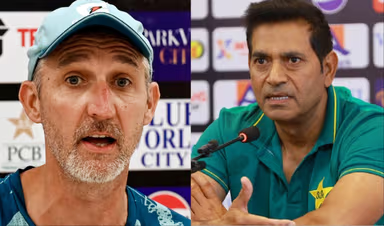
Former Pakistan Test head coach Jason Gillespie has once again launched a scathing attack on Pakistan Cricket Board (PCB) selector chairman Aaqib Javed, accusing him of undermining his authority and contributing to the decline of Pakistan cricket.
Gillespie, who resigned after only eight months in the job, said his experience with the PCB left him questioning his future in coaching and claimed Pakistan cricket would continue to go backwards as long as Javed remained in his position.
Gillespie was appointed Pakistan’s Test head coach in April 2024 but resigned in December of the same year.
Speaking about the volatile nature of Pakistan cricket, the 51-year-old Australian said he had been warned before accepting the job that the environment could be chaotic.
Despite those warnings, Gillespie described coaching Pakistan as an opportunity he was grateful for. He said Pakistan’s rich cricket history and its passionate supporters made the role particularly appealing.
He also believed he could help rebuild the Test team, particularly Pakistan’s long-standing reputation for producing world-class fast bowlers.
Aaqib Javed appointment changed everything
Gillespie said the original vision presented to him was to revive Pakistan’s fast-bowling culture by preparing pitches offering greater bounce and carry.
According to Gillespie, that approach changed after Aaqib Javed was appointed. He said Javed appeared to take control of virtually every aspect of Pakistan cricket, leaving him with little influence over the Test side, players, staff or selection.
Gillespie said the appointment “fundamentally altered the landscape” and claimed his relationship with Pakistan cricket changed completely after Javed arrived.
The Australian said his experience with the PCB was personally damaging and left him questioning whether he wanted to remain involved in coaching. He accused Javed of disrespecting and undermining him, alleging that their relationship became difficult from their first meeting.
Gillespie said Javed arrived with an attitude intended to demonstrate that he was in charge and repeatedly presented decisions without meaningful collaboration. Gillespie said he pushed back against some of Javed’s views but felt the selector chairman had already made up his mind.
According to Gillespie, Javed had the backing of the PCB chairman and board, which made him feel effectively untouchable.
Rejects criticism over time in Pakistan
Gillespie also hit back at criticism from Javed over the amount of time he and former Pakistan white-ball head coach Gary Kirsten spent in the country.
He said the details of their contracts were a matter between the coaches and the PCB and accused Javed of interfering in matters outside his responsibility.
Gillespie insisted that both he and Kirsten were willing to spend time in Pakistan for training camps, domestic cricket and preparations for upcoming series.
However, he said foreign coaches could reasonably return home during periods when there was no international cricket, particularly when coaching responsibilities were divided between two head coaches.
‘Never meet your heroes’
Gillespie also spoke about his admiration for Pakistan’s legendary fast bowlers before his experience working with Javed.
He said he grew up watching and admiring Wasim Akram, Waqar Younis and Aaqib Javed. While he had met and admired Wasim and Waqar, Gillespie said his perception of Javed changed dramatically after working with him.
He described Javed as an example of the old saying that people should “never meet your heroes.”
Gillespie also offered advice to Mike Hesson, the current Pakistan white-ball head coach who has been assigned to take charge of the Test side from Sarfaraz Ahmed for the Edgbaston match.
Gillespie said Hesson is an excellent coach and a good person, but urged him to trust his instincts and avoid becoming a “yes man.” He expressed hope that Hesson would not become caught up in Pakistan cricket’s internal problems simply because he was receiving a salary.
PCB still owes Gillespie money
Gillespie claimed the PCB still owes him thousands of dollars but said financial considerations never persuaded him to compromise his principles.
He said he could have remained quiet, agreed with decisions and continued collecting his salary, but that approach was never compatible with his character.
The former coach added that he believed he was likely to be removed from the position within months anyway and therefore chose not to change his stance.
Gillespie further alleged that attempts were made behind the scenes to undermine and eventually replace him during much of his eight-month tenure. He claimed people within Pakistan cricket told him that Javed was speaking negatively about him behind his back.
Gillespie said he was tired of Javed continuing to criticise him and warned that he could consider legal action if the comments continued.
‘Aaqib Javed is the problem’
Gillespie said he was deeply saddened by the current state of Pakistan cricket, particularly after the team’s turbulent tour of England.
Pakistan recently dropped seven players and several coaches following consecutive defeats at Headingley and Lord’s. Some of the discarded players were later ordered to attend a meeting with King Charles at Clarence House, with concerns reportedly raised about a low turnout embarrassing the PCB.
For Gillespie, the latest developments reflect the wider dysfunction he experienced during his tenure. He said Javed remains at the centre of the problem and claimed Pakistan cricket would continue moving backwards while he remains in charge.
He further said neither he nor former Pakistan white-ball head coach Gary Kirsten was able to complete two years with the PCB, while Aaqib Javed has remained with the board as chairman of selectors for around two years and continues to claim that Pakistan’s performances have improved.
However, Gillespie argued that Pakistan’s rankings have declined across all three formats during Aaqib Javed’s tenure.
Calls for stronger cricket leadership
Gillespie said Pakistan needs strong leadership from people with genuine cricket expertise and argued that coaches should be given greater authority over team-building decisions. He criticised the practice of PCB officials sitting in offices and deciding who should captain the national team.
Instead, Gillespie called for the appointment of the right coach, giving that coach time to establish stability, allowing him to choose the captain and then rebuilding Pakistan cricket from the ground up.
He said Pakistan cricket currently appears to be “going nowhere” and needs a fundamental change in leadership and decision-making.