



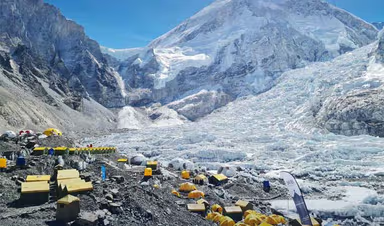
Human activity at Everest Base Camp is contributing enough heat to melt an estimated 2,500 tonnes of ice and snow from the Khumbu Glacier every year, according to new research.
The study found that fuel burned at the camp, combined with heat from urine discharged directly onto the glacier, produced enough energy during the 2023 climbing season to melt 2,492 tonnes of ice and snow.
An international team of researchers studied the Khumbu Glacier, where Everest Base Camp is located on the Nepalese side of Mount Everest.
During the spring climbing season, thousands of mountaineers, guides and support workers gather at the camp, transforming it into a crowded temporary village.
The camp includes espresso cafes, large-screen televisions, high-speed internet, hot showers and heated tent floors, reflecting the growing infrastructure supporting climbers at high altitude.
The researchers published their findings in the journal Regional Environmental Change.
Fuel use generates huge amounts of heat
The study examined the energy consumption of roughly 1,600 tents operating at Everest Base Camp during the 50-day spring season in 2023.
During that period, the camp consumed 824 canisters of liquefied petroleum gas, 18,935 litres of kerosene and 5,130 litres of petrol for cooking, heating and generating power.
Combined with heat associated with human urine, the researchers calculated total energy output at 849,174 megajoules.
That amount of energy was estimated to be enough to melt 2,492 tonnes of ice and snow.
The researchers gave a margin of error ranging from 1,964 to 3,020 tonnes, highlighting the uncertainty involved in estimating the precise amount of ice melt caused by the camp’s activities.
The amount of water represented by the estimated melt could fill an Olympic-sized swimming pool, around 83 tanker trucks or approximately 16,700 standard bathtubs.
Urine an unexpected source of heat
The researchers found that human urine was a significant source of heat in its own right. Climbers and guides consume large quantities of water at high altitude to avoid dehydration, collectively producing around 6,000 litres of urine every day.
While solid waste is collected and transported back down the mountain, much of the urine is discharged directly onto the glacier.
The study estimated that heat from urine alone could melt around 154 tonnes of ice during a single climbing season.
Satellite observations also pointed to a broader warming trend around Everest Base Camp. Researchers analysed Landsat satellite imagery covering the period from 1991 to 2023 and found that surface temperatures at the camp had increased by an average of 0.28°C per year.
That rate was roughly twice the warming recorded on the surrounding Khumbu Glacier.
The research team included Kim Lal Gautam, a senior surveyor at Nepal’s Department of Land Management.
Researchers say real impact could be higher
The researchers stressed that their calculations did not account for several other sources of human-generated heat around the base camp. These included helicopter flights, the body heat produced by climbers and support workers, and the yaks used to transport supplies to the area.
As a result, the study suggests that the overall human contribution to local warming and ice melt could be greater than its estimate.
Despite highlighting the impact of activity at Everest Base Camp, the researchers emphasised that climate change remains the primary driver of glacial melting on Mount Everest.
However, they warned that concentrating thousands of people on a glacier that is already melting rapidly is not sustainable year after year.
The researchers argued that the growing seasonal population and associated energy use place additional pressure on an already vulnerable glacial environment.
“In the long term, relocating the base camp from the glacier to a stable nearby area should be considered,” the researchers said.
Their findings add to growing concerns about the environmental footprint of tourism and mountaineering in the Everest region, where increasing human activity is taking place alongside rapid changes in the Himalayan cryosphere.