



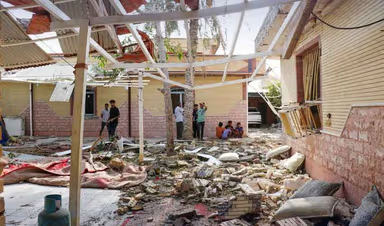
The United States is investigating a deadly strike on an Iranian wedding in southern Iran after a Reuters analysis found that the explosion was likely caused by a direct hit from a US munition.
US Vice President JD Vance said Washington wanted to establish what happened, while Iranian officials blamed the United States for the deaths and warned that the attack would not go unanswered.
Vance told reporters on Thursday that the United States was looking into the incident, saying Washington wanted to determine exactly what had happened.
“We’re investigating it because obviously we care. We want to know,” Vance said. He added that if US forces had made a mistake, the military would investigate it and use the findings to improve its operations.
“If we do make mistakes, again, this is a big difference between us and Iran, when our military makes mistakes, they learn from them to try to get better from them,” Vance said.
The US military said it was aware of Iranian reports about the strike but stressed that it “never targets civilians.”
Analysis points to direct US munition hit
An explosion tore through a wedding celebration in the southern Iranian town of Kuhestak on Tuesday night, in an area along the Strait of Hormuz that was subjected to heavy US airstrikes.
Reuters shared verified photographs and videos of the scene with four military weapons experts. Their analysis found that the pattern of destruction was consistent with a direct munition strike rather than secondary damage caused by a weapon ricocheting from another target.
Three of the experts said the munition was likely a US weapon rather than an errant Iranian air-defence missile. One expert suggested the weapon may simply have missed its intended objective.
The United States has not accepted responsibility for the incident.
A US official, speaking on condition of anonymity, said Washington was examining several possible explanations for the casualties, including a direct US strike, a ricochet from an Iranian air-defence missile or an errant interceptor.
Death toll rises as families mourn
Iranian state television reported on Thursday that a 22-year-old woman died in hospital following the strike, bringing the reported death toll to five. Iranian officials said nearly 70 people were wounded.
Other Iranian reports said at least four people were killed and 68 wounded in the attack, with a four-year-old child among those killed.
The strike took place at around 8pm on Tuesday in Kuhestak, in Sirik County, Hormozgan Province, on Iran’s Strait of Hormuz coast.
Funeral-goers gathered outside the village on Thursday afternoon to mourn victims of the attack. At a funeral for four of those killed, Iran’s Mehr news agency showed a pickup truck carrying a flag-draped coffin beneath a canopy of palm fronds.
A reporter standing in front of the vehicle identified one victim as Amir-Mohammad Karimi, a four-year-old child, and blamed the United States for his death.
Other footage showed mourners throwing flower petals into the air as mournful music played through a loudspeaker. A coffin was also carried past soldiers standing at attention with rifles.
“If it was a military location, it wouldn’t be so painful. This was a wedding ceremony, but they turned people’s joy into mourning,” the semi-official Tasnim news agency quoted a local man as saying.
IRGC chief vows revenge
Iran’s Islamic Revolutionary Guard Corps chief, General Ahmad Vahidi, vowed that the deaths at the wedding would be avenged.
“The pure blood of these oppressed martyrs… will not go unanswered and will definitely be avenged,” Vahidi said in a statement carried by Iranian state television.
In a message to the victims’ families, Vahidi expressed condolences over the attack and said the IRGC and Iran’s other armed forces would continue protecting the country’s security and stability.
He said Iranian forces had remained on guard over the lives of those killed and other victims during what he described as the second and third US-Israeli-imposed wars, particularly the “Battle of Hormuz.”
Vahidi condemned the strike as a terrorist and inhumane act, saying it had once again exposed what he called the “evil and demonic face” of the United States. He accused Washington of deliberately trying to deprive Iranians of joy and spread fear among civilians.
“This horrific crime, committed in the safe confines of our beloved homeland and among innocent women, men and children attending a wedding celebration, demonstrates the depth of the longstanding hostility and hatred of the enemies of the Islamic Revolution and the Islamic establishment,” Vahidi said.
He described the incident as a heartbreaking and tragic loss and said the blood of the victims would ultimately catch up with those who ordered and carried out the attack.
Vahidi also said Iran’s armed forces would continue, with “the utmost power and resolve,” to protect the security and tranquillity of the Iranian people and the country.
Iran calls strike war crime
Iran’s Interests Protection Office in Cairo described the attack as a “war crime” and an apparent violation of international law.
The office said the bombing of a residential building in the Kuhestak area of Sirik had again exposed what it called the “true and brutal face” of the United States. It said more than 70 women, men and children were killed or wounded in the attack.
The Iranian office argued that deliberately targeting a civilian wedding ceremony would constitute a serious violation of international humanitarian law, citing Common Article 3 of the four Geneva Conventions, Additional Protocol I on the protection of civilians during armed conflicts and provisions of the Rome Statute of the International Criminal Court.
It called on the international community, particularly the United Nations and the UN Security Council, not to remain silent over what it described as an apparent war crime.
The Iranian mission urged immediate and effective international action to halt US attacks and hold those responsible accountable. It also said the incident and similar attacks would remain part of the historical memory of the Iranian people.
According to the statement, Iran’s government intends to pursue the matter through diplomatic and legal channels in international forums and seek accountability for those responsible.
Wedding strike follows deadly school attack
The incident comes roughly six months after another deadly strike destroyed a primary school in Iran.
Iranian officials said that attack killed more than 175 children and teachers. Reuters previously reported that an initial internal US military investigation indicated US forces were likely responsible.
The Pentagon has not publicly released the findings of that investigation.
The latest wedding strike is therefore likely to add further domestic pressure on the Trump administration, particularly as questions grow over civilian casualties and the continuing US-Iran conflict.
US strikes triggered fresh escalation
Washington launched the latest round of airstrikes on Tuesday, targeting what it said were military positions along Iran’s coast. The United States said the attacks were carried out in retaliation for Iranian strikes on commercial shipping in the Strait of Hormuz.
Iran reported 18 deaths from the latest US assault.
Tehran responded on Wednesday by attacking US bases in Iraq, Jordan, Qatar, Kuwait and Bahrain, followed by further attacks early Thursday that Iran said targeted another US base in Kuwait.
Kuwait’s military said its air defences intercepted missiles and drones.
The escalation appeared to ease later on Thursday, however, with no further major attacks reported by either side after the exchange of fire.
Oil prices climb as Iran war intensifies
The latest escalation has also affected global energy markets.
Oil prices rose for a fourth consecutive day on Thursday, with Brent crude futures climbing above $96 a barrel, reaching levels not seen since July.
The Strait of Hormuz remains a critical concern because the waterway carries a major share of global oil shipments. Continued attacks and uncertainty around maritime traffic have raised fears that a prolonged conflict could trigger a broader energy crisis.
The renewed fighting is also increasing political pressure on President Donald Trump, whose approval ratings have been weighed down by the conflict and higher fuel prices ahead of the crucial November midterm elections.
The US administration has not acknowledged responsibility for the wedding strike, but the ongoing investigation and Reuters’ weapons analysis are likely to intensify scrutiny over civilian casualties in the Iran conflict.