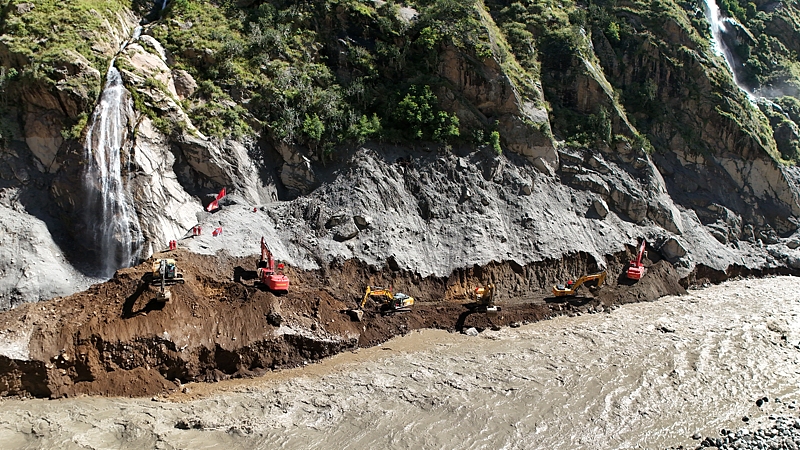
Chinese rescuers reopened a major highway to a mudslide-stricken land port in southwest China’s Xizang Autonomous Region on Wednesday morning, following round-the-clock rescue operations, in a major breakthrough following last week’s deadly mudslide.
Reporters from China Media Group (CMG) at Gyirong Port said large vehicles and heavy equipment have accessed the core disaster zone via the G216 national highway to conduct more extensive, in-depth rescue efforts for those still unaccounted for.
Chinese authorities launched full-scale rescue operations after the mudslide, caused by an ice-rock avalanche in Nepal, hit Gyirong Port on August 26, claiming 16 lives and leaving 546 others missing at the border port as of 6 p.m. on Saturday.
‘No giving up’
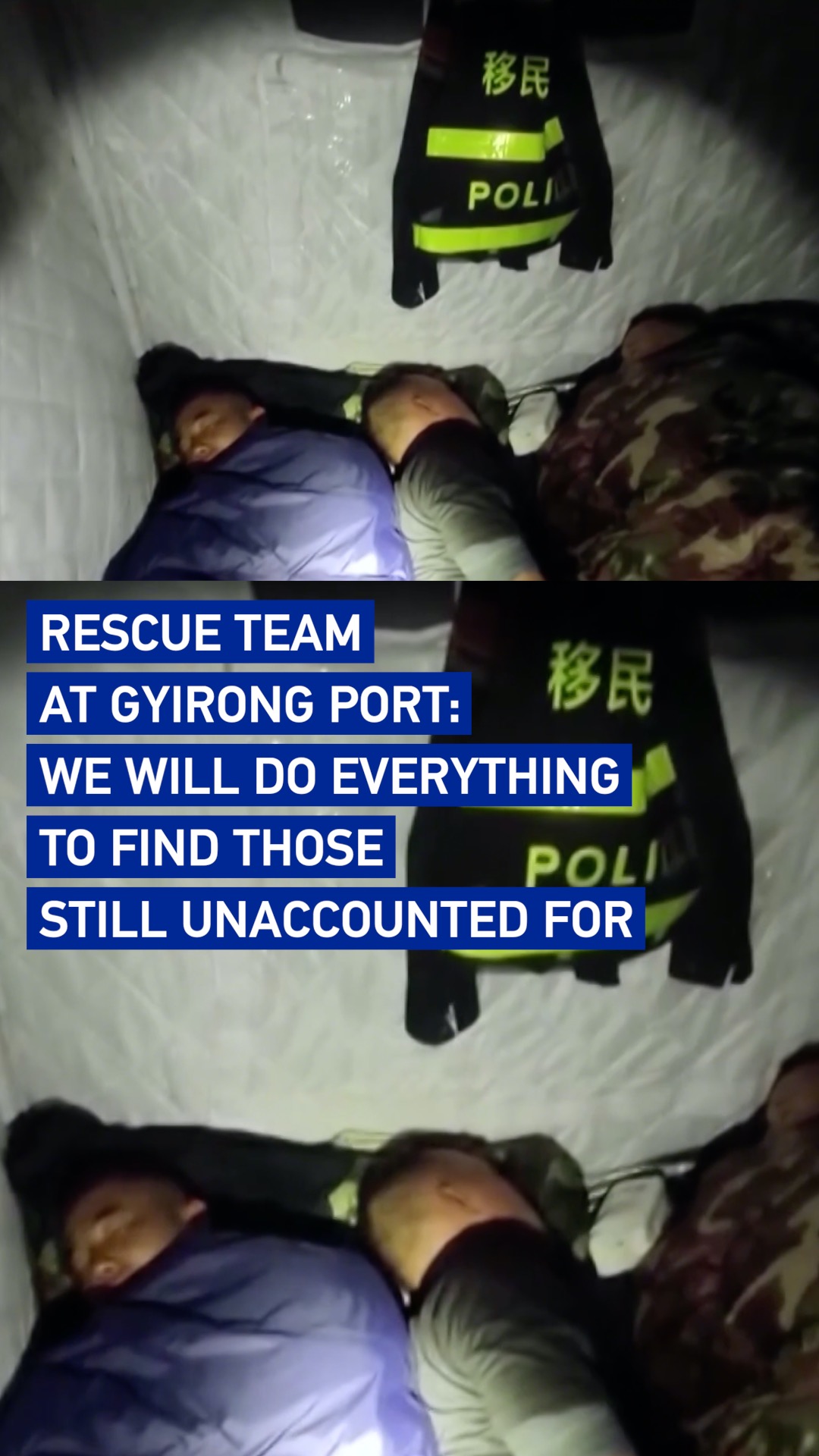
Rescue workers who were airlifted by helicopter into the core zone of Gyirong Port, including Xizang border police officers, have voiced their commitment despite tough challenges.
“We will accelerate our search. We will not give up, we will not abandon anyone, and we will do everything in our power to find those still unaccounted for,” said Ye Yi, a police officer with the Xigaze Border Control Detachment of the Xizang General Border Inspection Station.
Rescue operations have been severely hampered by difficult terrain, harsh weather conditions and the sheer severity of the disaster itself. According to experts, the impact of the devastating mudslide was worsened by the steep drop in elevation, the high speed of the flow and the valley’s narrow confines.
The mud has significantly slowed rescue teams’ movement and reduced the effectiveness of some commonly used detection equipment. In certain areas, the sediment is knee-deep or even waist-deep, according to rescuers on site.
Despite these challenges, one rescue team told CMG that it was racing against time with a multi-pronged approach: sending ground teams to conduct manual searches – tapping, shouting and listening for any sign of life, inch by inch; deploying two sniffer dogs across designated zones; and using advanced instruments, including life-detection devices, to pinpoint the location of anyone buried under the debris.
Over recent days, shallow-layer searches have covered the entire port area, with the surface layer already combed multiple times, rescuers said.

Full communications coverage restored
Telecom operators in Xizang had restored one base station and added 12 emergency ones in the mudslide-hit areas by 5 p.m. on Tuesday, securing full and uninterrupted communications for command, rescue and supply coordination.
Meanwhile, local telecom authorities have rolled out an integrated air-ground support system, deploying multiple communications relay drones, including large unmanned aerial vehicle the Wing Loong.
Medical teams ramp up post-disaster support
Temporary settlement sites are adequately supplied with essential materials, according to CMG reporters. Medical personnel have been stationed at the municipal, county and township levels to conduct routine health checkups and provide psychological counseling.
More than 150 villagers have been accommodated at three settlement sites in Jifu Village, Gyirong County.
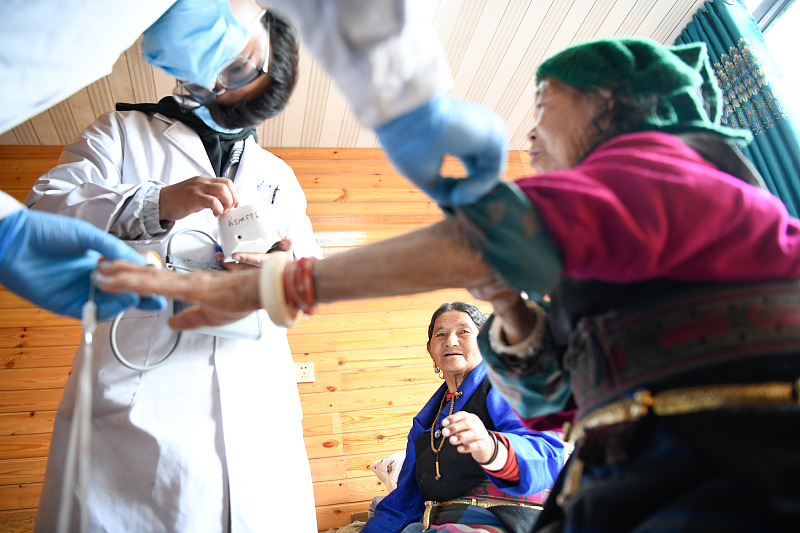
Medical workers conduct health checks for evacuees resettled in Jifu Village of Gyirong County, August 29, 2026. /VCG
Medical teams from the People’s Liberation Army Xizang Military Command are continuing to deliver medicines, offer medical treatment and provide psychological support to the displaced residents.
Meanwhile, epidemic prevention and disinfection teams are focusing on key areas such as residential zones and public walkways, carrying out comprehensive sanitization operations to ensure public health and safety.
Chinese DNA experts, second relief supplies arrive in Nepal
China sent its second batch of emergency supplies and a team of DNA experts to Nepal’s capital by air on Tuesday, following the first batch of aid that reached the country on Sunday.
The latest aid package, tailored to Nepal’s on-the-ground needs, includes drones, equipment and reagent for DNA testing, and equipment for water purification and lighting.
Five DNA identification specialists, who made up China’s third expert team to Nepal, traveled on the same aircraft. They lost no time after touching down, heading straight for the disaster-hit areas to assist Nepal in their on-ground operations.
According to Nepalese authorities on Tuesday, the death toll from the massive mudslide had risen to 1,068, with 4,606 people still missing.

Guo Jiakun, spokesperson for the Chinese Foreign Ministry, reiterated on Tuesday that China has been maintaining sound communication with Nepal in the wake of the disaster.
The two sides have cooperated smoothly in fields including meteorology, water conservancy, and disaster prevention and mitigation, and remained in sound communication on information sharing, Guo said at a regular press briefing.
“China will stand firmly together with Nepal and jointly overcome the difficulties as part of our efforts to carry forward the traditional friendship as neighboring countries.”
Guo also stressed that China is “making every effort” to search for and rescue Chinese and foreign nationals who are unaccounted for.
The Chinese spokesperson added that the ministry is in close communication with foreign embassies to jointly identify missing foreign nationals and properly handle follow-up matters.