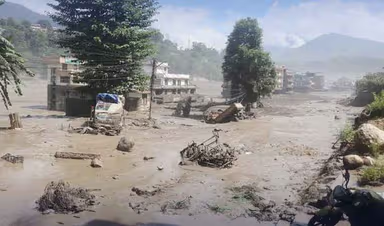
The death toll from catastrophic flooding in Nepal and China has crossed 1,000, while thousands of people remain missing as rescue teams battle unstable terrain, deep mud and destroyed infrastructure across the Himalayan disaster zone.
Nepal’s disaster agency said 987 people had died and 3,916 were missing, including 583 foreigners. China reported 16 deaths and 546 missing people, including 261 foreigners, in its latest update.
The first 72 hours after a disaster are considered critical for rescue operations, and hopes of finding thousands of missing people alive are now fading.
Despite the passage of time, rescue teams continue searching through mud, rocks and debris. Difficult terrain, persistent floodwaters, landslides and bad weather have made operations particularly challenging.
The scale of the destruction has also made it difficult for rescuers to reach remote communities, with roads and bridges washed away and large areas cut off.
Hundreds of hydropower workers feared trapped
One of the biggest rescue efforts is focused on around 900 missing hydropower workers in Nepal, with hundreds feared trapped inside tunnels and underground areas at 12 hydropower projects.
Nepal Army spokesperson Brigadier General Raja Ram Basnet said a large amount of debris had accumulated inside the tunnels, making it extremely difficult for rescuers to gain access.
About 250 people were rescued from the Upper Trishuli Hydroelectric Project over the weekend, while army engineers began blasting operations to reach another 42 workers believed to be missing.
According to Nepalese authorities, roughly 500 workers are believed to be trapped inside tunnels at hydropower sites.
Visuals released by the Nepal Army showed rescue teams entering dark, debris-filled tunnels, wading through mud and water and climbing over rocks in search of survivors.
Foreign experts are also assisting Nepalese teams at several hydropower projects.
Families wait for news of missing workers
The prolonged rescue operation has left families desperate for information about their missing relatives.
Engineers have been pumping air into the tunnels, and a rescue team managed to enter one tunnel leading to a hydropower plant on Monday. The team later withdrew after finding no one inside.
Families of the missing workers said the air-pumping operation should have started earlier.
Anushila Bhandari, whose 33-year-old engineer husband Aurus Bhandari is missing from a project site, told BBC Nepali that she wished he could be found and brought home.
Sita Pandey, whose husband was working at a hydropower plant when the floods struck, said she still had 50% hope that he was alive because an oxygen system was available inside the facility.
Another relative of a trapped worker, Jiban Khadka, described the rescue effort as frustratingly slow and urged authorities to move faster, saying every second was important for the families.
At least 11,814 people rescued
Nepalese authorities said at least 11,814 people have been rescued so far. Helicopters and other aircraft are being used to reach stranded communities in areas where flooding and landslides have destroyed roads and bridges.
Authorities have also intensified relief operations to provide assistance to survivors in places where transportation routes have been damaged or completely cut off.
Helicopter pilot Bimal Sharma, who has been flying rescue and relief missions since the disaster began, said the destruction in Timure, a border town near Tibet that he had known for years, was shocking.
He described the area as looking like an entirely different landscape and said the expressions of the people he rescued showed the depth of their suffering.
China steps up rescue operations
On the Chinese side, rescue teams have been searching areas affected by mudslides, particularly around the Gyirong Port border crossing, which was destroyed by the disaster. Search teams accompanied by dogs have been checking gaps between rocks and debris for signs of life.
Other crews have been using heavy machinery to reopen a major highway leading to Gyirong Port. The road is considered important for transporting rescue equipment, personnel and relief supplies into the disaster zone.
The disaster began on August 26, when a major glacial collapse in the Himalayas sent huge quantities of rock, ice and meltwater into valleys below. The collapse triggered powerful floods that swept through river valleys in Nepal and Tibet, carrying mud and rocks downstream.
The flooding destroyed homes, villages, roads, bridges and other vital infrastructure, including power facilities.
Scientists examining satellite imagery said the collapse appears to have involved the failure of bedrock beneath a glacier in the Himalayan region. The rockfall was powerful enough to register as a magnitude 5.2 seismic event.
Climate change raises fresh concerns
The disaster has renewed concerns about the impact of climate change on mountain regions and glaciers.
The Red Cross estimates that more than 93,000 people have been affected by the disaster, heightening fears that the climate crisis is destabilising geology in mountain and polar regions.
Nepalese Prime Minister Balendra Shah described the floods as an unprecedented and devastating natural disaster, saying the scale of the destruction made it difficult to compile a complete assessment. He later said the floods were not an ordinary event and that rescue operations had been intensified.
He warned that risks in the Himalayan region are increasing alongside climate change.
China’s state-run CCTV reported that the flooding was caused by glacier instability linked to the long-term effects of global warming, describing it as a new and prominent feature of cryosphere disasters on the Tibetan plateau.
Two Nepalese officials said China had not shared sufficient information about glacier risks and water levels following a meeting earlier this year aimed at strengthening cooperation. They warned that the lack of information could hamper future disaster preparedness.
International teams join rescue efforts
The rescue operation in Nepal is being led by an international team involving Chinese and Nepalese military personnel. Experts from India, South Korea and Australia are also participating in the rescue effort.
Nepal depends heavily on hydropower and has spent years developing projects along its mountainous river systems. Authorities said at least 11 hydropower projects, either completed or under construction, were damaged by the floods.
Prime Minister Shah said 279 people had been rescued from hydropower sites, while efforts continued to locate those still missing.
Bodies overwhelm morgues
The huge number of fatalities has overwhelmed local facilities, forcing authorities to resort to temporary burials for unidentified victims.
In Chitwan, far downstream from the areas initially hit by the floods, nearly 300 bodies were reportedly brought to riverbanks by the country’s river systems.
With morgues and freezers unable to accommodate the remains, authorities began burying unidentified victims temporarily.
A large section of forest outside the city was dug up over the weekend, where medical staff and volunteers worked to recover remains and collect DNA samples for identification.
The Ministry of Health said only a small proportion of the recovered bodies had been identified, with a spokesperson putting the figure at around 4% of the reported 900 recovered remains.
The air in the area was filled with the smell of decomposition as workers wearing white personal protective equipment, including masks, carried unidentified bodies into trucks.
DNA testing to help families identify victims
Ganesh Aryaal, the chief district officer, said relatives would still be able to recover the remains of their loved ones once DNA testing identifies them.
He said authorities had been overwhelmed by the number of bodies and did not have enough freezer capacity, leaving temporary burial as the only available option.
As rescue and relief operations continue, authorities remain focused on reaching isolated communities, searching for missing people and identifying victims of one of the deadliest disasters to hit the Himalayan region in recent years.