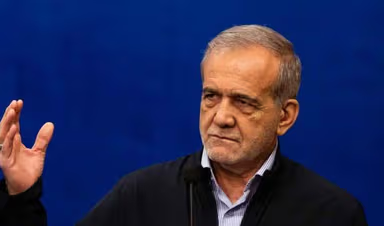
Iranian President Masoud Pezeshkian has said Tehran is ready to cooperate with all countries in the region, including Saudi Arabia, the UAE and Pakistan, while outlining conditions for reopening the Strait of Hormuz.
In a televised interview with Iranian state television, Pezeshkian also defended the Islamabad Memorandum of Understanding, highlighted Iran’s economic resilience under sanctions and stressed that national unity remains the country’s greatest strength against US pressure.
Pezeshkian said Iran should no longer delay efforts to establish better relations with its neighbours and other Muslim countries.
He said regional states should sit together, resolve their disputes through dialogue and work toward collective security and stability. “We are brothers and are not rulers over one another,” he said, stressing that no country should seek to dominate another.
The Iranian president said Tehran is ready for cooperation and understanding with Pakistan, Afghanistan, Saudi Arabia, Türkiye, the United Arab Emirates, Qatar, Oman, Egypt, Azerbaijan and Turkmenistan.
He added that Iran needs to reform its approach toward neighbouring countries and find common ground through dialogue while remaining firm on core principles and showing flexibility on secondary issues.
Strait of Hormuz reopening linked to US commitments
Pezeshkian said Iran could reopen the Strait of Hormuz if the United States fulfils its obligations under the Islamabad agreement. He said the US would need to lift sanctions and the blockade, release frozen Iranian assets and meet other commitments outlined under the agreement. He also linked the reopening of the strategic waterway to the end of the war in Lebanon.
According to Pezeshkian, Iran is now making progress on a revised roadmap for managing maritime traffic through the Strait of Hormuz.
The roadmap was prepared by the Islamic Revolutionary Guard Corps (IRGC), military officials and Iran’s diplomatic negotiating team and has been approved by the Supreme Leader.
Oman involved in reopening plan
Pezeshkian said Iran had discussed the maritime arrangements with Oman. While Oman initially cooperated before raising reservations, more recent talks resulted in an understanding over a coordinated plan for reopening the route.
He said Iran would closely monitor developments to ensure that the United States fulfils its reciprocal commitments if the Strait of Hormuz is reopened under the agreed framework.
Those commitments, he said, include lifting sanctions and blockades, releasing Iranian funds connected to the oil and petrochemical sectors, resuming investment, ending military operations in Lebanon and ensuring Israel respects international boundaries.
Pezeshkian reaffirmed that any decision to reopen the Strait would be taken in accordance with official Iranian state policy.
Iran says Islamabad agreement reached by consensus
Pezeshkian described the Islamabad understanding as a major achievement, saying domestic and international experts had viewed Iran as the true winner of the agreement. He said the agreement was discussed extensively by senior Iranian officials, including military commanders, the heads of the judiciary and legislature and cabinet ministers.
According to the president, the Supreme Leader had proposed that approval by three-fourths of the Supreme National Security Council (SNSC) would be enough to finalise the decision. He said 12 of the council’s 13 members voted in favour.
Pezeshkian said the agreement therefore reflected collective decision-making and expert deliberations rather than the position of a single institution.
US commitments and breakdown of agreement
The Iranian president said nine clauses of the agreement set out specific US commitments, alongside several joint clauses and one nuclear-related provision that was to be discussed in further negotiations.
He said implementation initially produced tangible results, including the lifting of some blockades and sanctions, an agreement for the conflict in Lebanon to end and negotiations over the release of frozen Iranian assets.
Iranian experts were also preparing plans for as much as $300 billion in foreign investment, according to Pezeshkian. He said preliminary discussions had taken place with Qatar and the UAE over the proposed investment package, but regional conflicts had temporarily halted progress.
Pezeshkian said arrangements were also being developed to normalise traffic through the Strait of Hormuz under Iran’s regulatory framework. However, he claimed the agreement eventually broke down because the opposing side failed to follow the established guidelines.
Oil exports despite sanctions
Pezeshkian said Iran had sold around 90 million barrels of oil during the implementation of the interim agreement. He also said Iran benefited from relief related to banking and petrochemical sanctions and made progress toward unfreezing blocked assets.
At the same time, he claimed that continuing US sanctions and the blockade of the Strait of Hormuz had reduced Iran’s imports and exports by as much as 35%.
The president said Iran had remained economically resilient despite sanctions, inflation, unemployment and other difficulties.
Pezeshkian attributed Iran’s ability to withstand external pressure to national unity and public support. He said that despite economic difficulties, inflation and employment challenges, the Iranian people had remained supportive, allowing the country to remain steadfast.
The president warned that military capabilities alone cannot guarantee national survival if a country is divided internally. He argued that even states possessing nuclear weapons had collapsed because of internal divisions. He said the government would therefore avoid divisive rhetoric and focus on shared interests to confront pressure from the United States and its allies.
Pezeshkian also paid tribute at the beginning of his televised interview to the late Supreme Leader of the Islamic Revolution, Ayatollah Khamenei, as well as those he described as the “martyrs” of the Revolution.
Tehran adopts cautious approach to negotiations
Pezeshkian said Iran remained open to negotiations but rejected an absolute, all-or-nothing approach to diplomacy. He called for measured and reciprocal steps, saying Tehran would honour its commitments as long as the other side remained compliant.
At the same time, he stressed that willingness to negotiate did not mean Iran placed complete trust in its counterparts. Any violation of an agreement, he said, would lead Tehran to act according to its own national interests.
He referred to guidance attributed to Imam Ali in his letter to Malik al-Ashtar, saying genuine offers of peace that align with divine guidance should be accepted while remaining vigilant against possible surprises from adversaries.
Major domestic energy challenges
The Iranian president also addressed domestic infrastructure problems, saying his administration had devoted significant effort to tackling systemic crises. He said Iran faced an electricity deficit of around 25,000 megawatts when his administration took office.
The shortage was worsened by damaged power facilities and declining hydroelectric generation caused by low water levels in dams, he said.
Pezeshkian said structural reforms were now underway to improve operational efficiency and manage the country’s energy constraints more effectively.
Pezeshkian concluded by reiterating that closer relations among Muslim countries were essential for regional security and stability. He said Islamic nations should resolve their problems through direct dialogue and cooperation rather than allowing divisions to deepen.
The president maintained that stronger regional unity, combined with Iran’s domestic cohesion, would help the country withstand pressure from Washington and its allies while creating opportunities for greater economic and diplomatic cooperation.