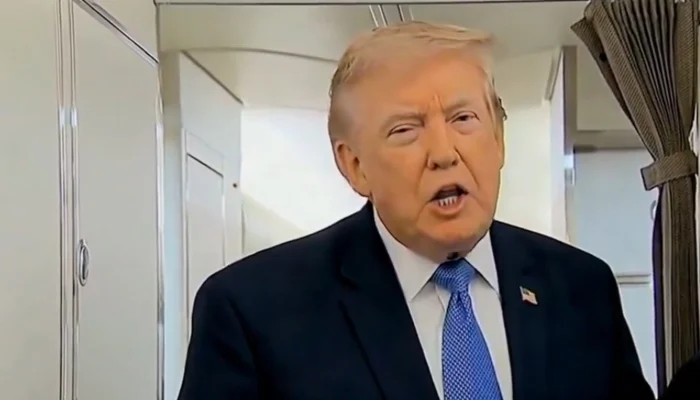
WASHINGTON: US President Donald Trump said negotiations with Iran will begin on Monday after he decided to hold off on new “disastrous” strikes against the Islamic republic to pursue a deal.
“Obviously, they don’t want to be attacked. They knew the extent of the attack because they saw it forming,” Trump told reporters on Sunday aboard Air Force One.
“Now what we’re doing is we’re talking to them in the form of a negotiation. It begins tomorrow afternoon,” he said, without providing further details of the venue of the talks or the participants.
On Saturday, the US president pulled back from threats of a massive attack against Iran, which he said would have been the biggest since World War II, saying the “perimeter” of a deal was there.
In his comments on Sunday, explaining his decision-making, Trump said he had been asked by Iran as well as US partners Saudi Arabia, the United Arab Emirates and Qatar to hold off on the strikes.
“When the allies asked to call it off, you’ve got to sort of say ‘Well, let’s see.’ And the reason they ask is they think there’s a deal,” Trump said.
“There’s a deal on (the Strait of) Hormuz, and then there will be a deal on the nuclear, or you might call it the denuclearisation of Iran.”
He reiterated that the scale of the planned strikes would have been “the biggest attack since World War II”.
“It would take many, many years to ever build it back if it could — I don’t think it would even be buildable,” Trump asserted.
He said Saudi Arabia’s Crown Prince Mohammed bin Salman had also urged against the strikes, warning of possible unintended consequences.
“I mean, will they be flooded with people pouring into their country and disaster? A lot of bad things can happen,” Trump said.
The war began on February 28 when the US and Israel launched surprise strikes against Iran, though months of on-off diplomacy have led to periods of relative calm.
A previous ceasefire deal, including the reopening of the Strait of Hormuz — a vital conduit for global energy supplies — fell through, and Iran has since tightened its control over the vital waterway as the two countries resumed attacks against each other in recent weeks.
Iranian diplomacy
Iran’s Foreign Minister Abbas Araqchi held phone calls with his Saudi counterpart, Prince Faisal bin Farhan, and Pakistan’s army chief, Asim Munir, to discuss diplomatic efforts, Iran’s state media reported on Sunday.
The official Iranian news agency IRNA reported earlier that negotiations between Tehran and Oman over the Strait of Hormuz were in their final stages, citing Iran’s Foreign Minister Abbas Araqchi.
Iranian Foreign Ministry spokesperson Esmaeil Baghaei said negotiations were focused on agreeing a new route through the strait, adding that it had “no link to the Strait of Hormuz being opened or closed. That is a separate discussion.”
Last month, Iran publicly rejected an Omani proposal, backed by Gulf states, to manage the strait they share. People familiar with the matter had told Reuters the plan included the collection of voluntary fees for using the strait.
Eli Cohen, Israel’s energy minister and a member of Prime Minister Benjamin Netanyahu’s security cabinet, said there was close security and intelligence coordination between Israel and the US on everything happening in the region.
But he added: “With or without an agreement, and regardless of any external commitments, if Iran attempts to renew its nuclear programme or advance its ballistic missile industries, we will be there. We will take action, and we will strike.”
Trump and Netanyahu met on Tuesday in Washington, with an Israeli official saying they had explored all possible paths to curb Iran’s nuclear programme, including diplomacy, economic pressure and force. Tehran denies it is seeking a nuclear weapon.