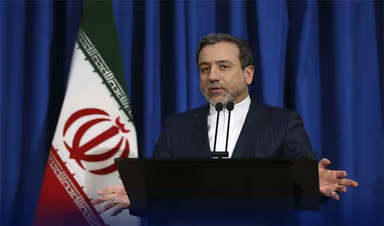
Iran called on Sunday for a new regional security framework involving Gulf countries without the involvement of outside powers, just hours after launching missile and drone strikes on US military bases in Bahrain and Kuwait in retaliation for recent American attacks.
Speaking during a visit to Baghdad, Iranian Foreign Minister Abbas Araghchi said lasting security in the Persian Gulf should be ensured by countries in the region, while urging all parties to uphold the US-Iran memorandum of understanding (MoU) aimed at ending the conflict.
Addressing a joint news conference in the Iraqi capital, Araghchi said the region needed a new security arrangement that includes all Gulf nations without the “presence or interference” of countries from outside the region.
“We should reach a new framework that includes all countries in the region and without the presence or interference of any country from outside the region,” he said.
The Iranian foreign minister welcomed Iraq’s proposal to hold talks involving Iran, Iraq and the Gulf Cooperation Council (GCC), saying such dialogue could strengthen regional stability.
Strikes follow US attacks on Iranian positions
Araghchi’s remarks came only hours after Iran’s Islamic Revolutionary Guard Corps (IRGC) said it had launched missile and drone attacks targeting eight US military sites in Kuwait and Bahrain.
The strikes were described as retaliation for recent US attacks on Iranian positions, further escalating tensions despite ongoing diplomatic efforts to preserve the interim peace agreement.
The latest exchange of attacks has placed renewed pressure on negotiations intended to end the war launched by the United States and Israel against Iran on February 28.
Warning over Strait of Hormuz routes
Araghchi also warned against bypassing maritime routes through the Strait of Hormuz that had been agreed upon with the United States under the interim understanding.
He said any attempt to introduce alternative or separate shipping arrangements would increase tensions, complicate the reopening of the strategic waterway and delay progress toward restoring normal maritime traffic.
“Any attempt to adopt new or separate arrangements compared to what is underway by the Islamic Republic of Iran will only lead to more complicated situations and delays in the reopening of the Strait of Hormuz and will increase the tensions, as we witnessed in the past two nights,” he said.
Despite Tehran’s position, vessel-tracking platforms showed that ships have continued using a non-Iranian-approved passage through the Strait.
A day earlier, the IRGC said Oman and the International Maritime Organization had announced a new shipping corridor without consulting Iran, warning vessels against using the route.
Fresh military exchanges deepen crisis
Araghchi’s warning followed new US military strikes carried out on Saturday against multiple targets inside Iran.
According to the US military, the attacks were launched in response to another assault on a commercial vessel transiting the Strait of Hormuz. Tehran then responded by targeting US military bases in the Gulf with missile and drone strikes.
The renewed hostilities have further strained the fragile ceasefire and diplomatic process established under the interim US-Iran agreement.
Lebanon remains part of agreement
The Iranian foreign minister also said the war in Lebanon must end under the first clause of the US-Iran memorandum of understanding.
He added that responsibility for Israeli attacks and Israel’s military withdrawal from Lebanon ultimately rests with the United States.
Calling for restraint from all sides, Araghchi urged every party to respect the memorandum of understanding and prevent the agreement from derailing.
“We must adhere to the memorandum of understanding and not allow this MoU to deviate from its course,” he said.