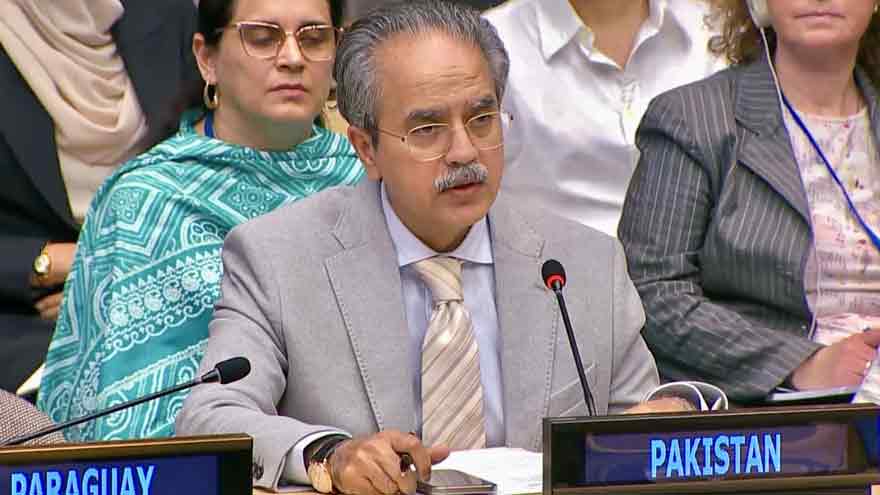
Pakistan has said that the world is facing a humanitarian emergency of extraordinary scale and complexity, as millions of people are struggling for survival as a result of consequences of the various events from conflicts and foreign occupations to climate disasters, poverty, food insecurity, displacement and natural disasters.
Taking part during the General Debate of the ECOSOC Humanitarian Affairs segment, Ambassador Asim Iftikhar Ahmad, Pakistan’s Permanent Representative to the UN, called for anchoring the transformation in approach in humanitarian principles, respect for international humanitarian law, stronger coordination, predictable financing and a renewed commitment to prevention.
“The central test is straightforward: whether assistance reaches all people in need, without discrimination, politicization, delay or denial,” he said.
The Pakistan Permanent Representative shared five proposals to make the transformation result-oriented.
While underlining that international humanitarian law must be upheld in all situations of armed conflict and foreign occupation, he said that violations must not be normalized, excused or ignored.
Safe, rapid, sustained and unhindered humanitarian access must be ensured in all situations, he said.
Ambassador Asim said that the humanitarian reset must restore trust, effectiveness and focus. He further suggested that it should strengthen principled humanitarian action, reduce fragmentation, improve delivery, reinforce accountability to affected people, and ensure that scarce resources are directed where needs are greatest.
While calling for timely, flexible and predictable humanitarian financing, he said that we should remember that chronic underfunding forces agencies to make impossible choices between food, shelter, medicine and protection.
He suggested that humanitarian action must be in sync with development, climate adaptation and disaster risk reduction, stating that while emergency relief saves lives, it is resilience that matters in the long run.
“Early warning, anticipatory action, preparedness and nationally led response capacities must be strengthened, particularly in vulnerable and disaster-prone countries,” he said.
He emphatically highlighted the need for addressing the root causes of conflicts in order to reduce humanitarian needs, which he said, required political will.
He said that disputes must be resolved through dialogue, diplomacy, mediation and peaceful settlement, in accordance with the UN Charter and Security Council resolution 2788.
He made it clear that humanitarian action is not an act of generosity; rather it is a duty of conscience and a responsibility under the UN Charter.
“The measure of our success will not be what we promise, but what we deliver,” he said while concluding the statement.