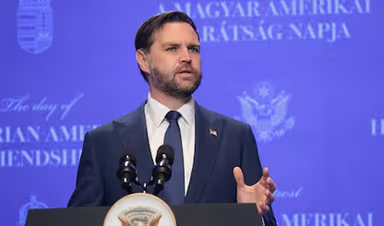
US Vice President JD Vance has said the US-Israel war on Iran could conclude within a week or take several months, as Washington continues to claim it is close to a deal with Tehran over its nuclear program.
In an interview with CBS, recorded early Tuesday and set to air later this week, Vance said the United States was “very close to achieving” a peace deal with Iran.
He said an agreement could “absolutely” come before the November midterm elections, but added that the timeline remained uncertain.
“I think that the deal could happen in the next week, but the deal could also happen months from now,” Vance said.
US wants long-term nuclear limits
Vance said Washington was seeking a deal that would be good for the United States economically and would address Iran’s nuclear program “for the long term.”
He said the goal was to ensure that Iran would not develop a nuclear weapon, not only during Donald Trump’s presidency but for future generations.
“That’s the goal of the policy. And I think we’re very close to achieving that goal. But we still got some wood to chop. We’re going to keep doing it,” he said.
US launches strikes after Apache crash
Hours after Vance’s remarks, the US Central Command announced that American forces had begun launching “self-defense strikes” on Iran.
CENTCOM said the strikes were a “proportional response to unjustified Iranian aggression” after a US Apache helicopter was downed near the Strait of Hormuz a day earlier.
Two Apache crew members were rescued by a US Navy sea drone in what officials described as the first operation of its kind by the US military. They were not injured in the crash.
Trump says deal could come in days
Earlier Tuesday, President Donald Trump wrote on Truth Social that the United States “must, of necessity, respond to the attack.”
At the same time, he claimed there was a “good chance” of signing a deal with Iran “in two or three days,” saying negotiations were in their “final throes.”
Trump later said Iranian forces had shot down the Apache helicopter that crashed near the Strait of Hormuz and vowed a US response.
The US and Israel launched the war against Iran in February, triggering Iranian retaliatory strikes against US Gulf allies.
The conflict also led to a blockade of the Strait of Hormuz, soaring global energy costs and a fragile ceasefire that has repeatedly come under pressure.
Over the past three and a half months, the Trump administration has repeatedly said it is close to a deal with Iran.
Trump has also accused Tehran of trying to stall talks and “outwait” him until the US midterm elections. Last month, he told cabinet members: “I don’t care about the midterms.”
Iran says no final agreement reached
Iran has acknowledged in recent weeks that discussions with the United States are continuing, but it says no final agreement has been reached.
Talks have been further complicated by Israel’s recent strikes across Beirut, which triggered retaliatory strikes from Iran.
Tehran considers Israel’s attacks a violation of the already fragile ceasefire.
Vance says Trump does not trust anyone
In the CBS interview, Vance said he did not believe Iran was simply trying to delay President Trump. He said Iran’s system takes time to reach consensus and repeated Trump’s position that he does not “trust anybody.”
Vance said Trump instead trusts his own negotiating ability, the administration’s capacity to negotiate and the enforcement provisions Washington hopes to secure in any final agreement.