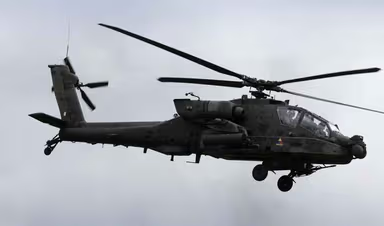
A United States Army Apache helicopter gunship went down near the Strait of Hormuz on Monday, adding fresh concern to an already volatile region. US President Donald Trump confirmed on Tuesday that the two crew members were safely rescued.
Trump said the United States would release an incident report later on Tuesday.
The New York Times first reported the incident, citing two people briefed on the matter. It was not immediately clear whether the Apache was shot down by Iranian fire, suffered a mechanical failure, or went down due to another cause.
One person familiar with the incident said the matter was under investigation and spoke on condition of anonymity.
The White House, US Department of State, and US Central Command initially did not respond to Reuters’ requests for comment. The Trump administration had not publicly disclosed the downed helicopter before The New York Times contacted the White House press office on Monday night.
The Apache went down after several days of rising regional hostilities, during which Israel and Iran exchanged military strikes before stepping back.
The latest escalation highlighted the fragile nature of the cease-fire after months of conflict between Washington, Tehran and Israel.
First Apache lost in conflict
According to The New York Times, this would be the first Apache helicopter lost since hostilities between the US and Iran began on February 28.
The report said Iran has claimed to have shot down around 30 US MQ-9 Reaper drones during the conflict. A number of US fighter jets have also reportedly been lost to hostile and friendly fire.
US military pressure in Strait of Hormuz
The US military has used Apache helicopters, MQ-9 Reaper drones, F/A-18 jets and F-35 attack aircraft as part of Central Command’s effort to challenge Iran’s effective closure of the Strait of Hormuz to most commercial traffic.
The AH-64 Apache, armed with Hellfire missiles, is considered one of the most powerful attack helicopters operating in the region. It is used to patrol the strategic waterway, deter small-boat attacks and shoot down drones.
The New York Times reported that Apaches are generally used for patrol missions but have recently been pushed deeper into Iran as part of a more aggressive posture by CENTCOM.
Last month, Central Command posted imagery on social media showing Adm. Brad Cooper, the head of the command, flying over waters in or near the strait ahead of a US Navy effort to guide commercial ships through the area.
That short-lived operation was called Project Freedom.
CENTCOM says Iranian drones shot down
CENTCOM said on Sunday that US forces had shot down two Iranian drones threatening international maritime traffic in the Strait of Hormuz over the weekend.
The command added that the US military remained “postured and ready” to continue defending against Iranian aggression.
US losses during war
Trump told NBC on Saturday that Iran’s military had been “totally destroyed” by joint US-Israeli strikes, claiming Tehran retained only 21% of its missile capacity.
However, the US has also suffered losses during the conflict. CENTCOM announced in April that 13 American soldiers had died during Operation Epic Fury, while 399 others were wounded.
In April, Iran also managed to shoot down a US Air Force F-15 Eagle, triggering an intense search for the pilot and navigator. Both crew members were later rescued.
Three US F-15s were also shot down by Kuwaiti air defenses in March in a friendly-fire incident, with all six crew members safely ejecting.