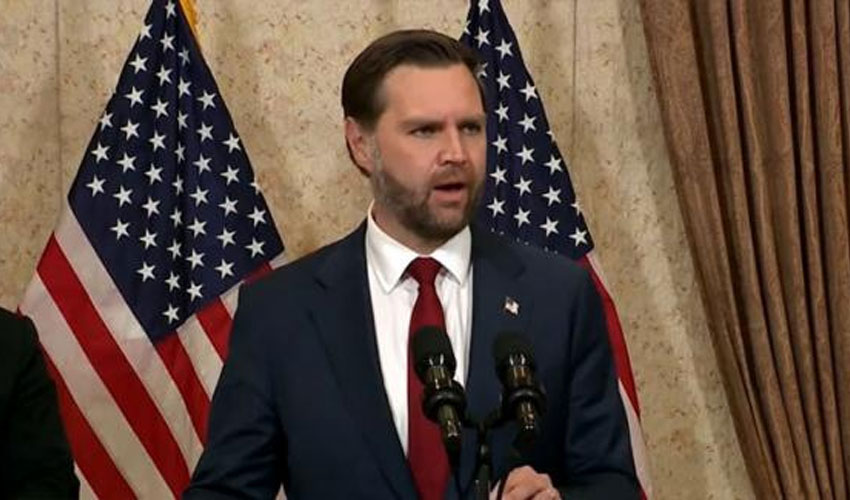
US Vice President JD Vance said Thursday that Washington and Tehran have made “a lot of progress” toward an agreement, but several sticking points remain before President Donald Trump can approve a potential memorandum of understanding.
Speaking to reporters on Thursday, Vance said the United States was “not there yet” with Iran, although both sides were close to a possible agreement.
“We’re going back and forth on a couple of language points. We’ve made a lot of progress here,” Vance said.
He added that it was “hard to say exactly when or if” President Trump would sign the memorandum of understanding.
“I can’t guarantee that we’re going to get there, but right now I feel pretty good about it,” Vance said.
Trump’s approval remains pending
Vance said Trump is not yet ready to endorse the agreement, despite progress in negotiations.
“Hopefully, we’ll continue to make progress, and the president will be in a position where he can endorse the agreement, but obviously, that’s still TBD,” he said.
Sources told Reuters that the United States and Iran had reached an agreement Thursday to extend their ceasefire and lift restrictions on shipping through the Strait of Hormuz, pending Trump’s approval.
Axios also reported that Trump had been briefed on the proposal but did not immediately sign off and would take time to consider it.
Nuclear issues remain key sticking points
Vance said the main unresolved issues involve Iran’s nuclear program, including its stockpile of highly enriched uranium and the question of future enrichment.
“There are a couple of issues on the nuclear stuff, the highly enriched stockpile, and also the question of enrichment,” Vance told reporters at Joint Base Andrews.
He said Washington believes Iran has so far been negotiating in “good faith.”
The United States has long demanded that Iran stop producing highly enriched uranium and dispose of its existing stockpile, which could theoretically be used to create nuclear weapons.
Proposed deal could extend ceasefire for 60 days
The reported memorandum of understanding would extend the ceasefire for 60 days and launch talks on the future of Iran’s nuclear program.
Earlier Thursday, US officials told the BBC that Washington and Tehran had agreed on a framework, pending approval by Trump and Iran’s leadership.
However, Iran’s semi-official Tasnim news agency reported that the deal had not been finalized or confirmed. The conflicting reports highlighted how fluid and uncertain the negotiations remain.
Strait of Hormuz shipping restrictions
The proposed deal reportedly includes unrestricted passage through the Strait of Hormuz, one of the world’s most important shipping routes.
Reports say Iran would have 30 days to remove mines from the narrow waterway. The United States would also lift its blockade on Iranian ports and issue sanctions waivers allowing Tehran to resume selling oil.
Ceasefire remains in place despite flare-ups
Vance said the ceasefire between the United States and Iran remains in place, despite recent exchanges of attacks. “These ceasefires are always a little messy,” he said, adding that “sometimes these things have little flare-ups.”
At the same time, Vance said the United States reserves the right to launch defensive strikes if needed.
Since the initial US-Iran ceasefire took effect on April 8, Trump has repeatedly suggested that both sides were close to a deal and that talks were progressing. However, no substantive results have yet been formally announced.
Trump is facing growing pressure to end the war, including from Gulf allies, Democrats who oppose the conflict, and some Republicans in Congress concerned about its length.
US officials have also warned that “option B,” meaning a return to combat operations, remains on the table.
If approved, an extension of the ceasefire would give US and Iranian negotiators more time to address complex technical issues. These include Iran’s nuclear program, its remaining highly enriched uranium stockpile, and the broader framework for a possible final agreement.
Trump has previously suggested that the United States could take Iran’s enriched uranium, or work with Tehran to dilute it either inside Iran or in a third country.
For now, Vance said both sides are close, but more progress is needed before any final agreement can be endorsed.