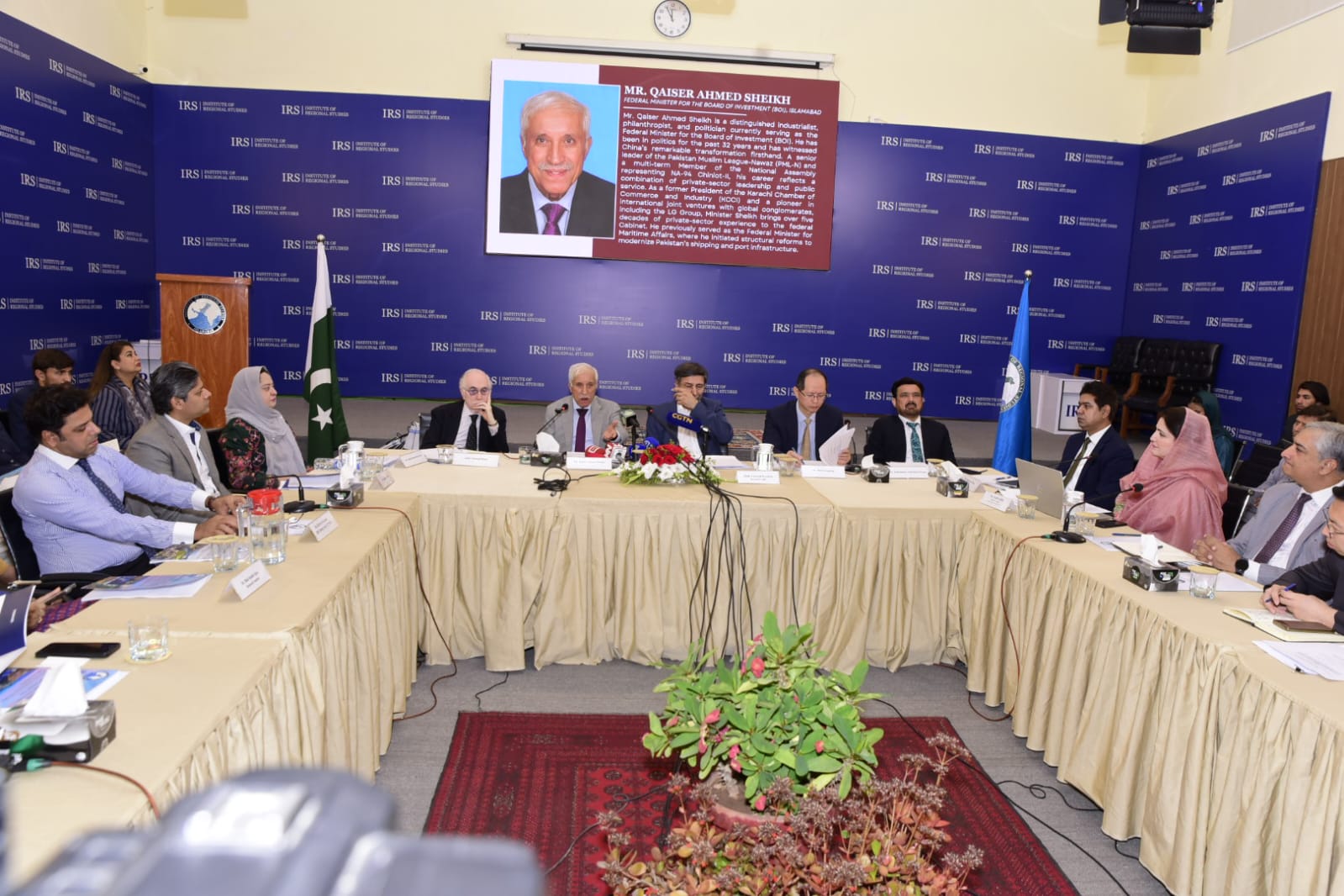
ISLAMABAD (DI NEWS) : The Institute of Regional Studies (IRS), Islamabad, convened a high-level policy dialogue titled “Strengthening Governance and Implementation Strategies for CPEC 2.0,” alongside the launch of two reports: “Unlocking CPEC Phase II: Building Capacity for Business-to-Business Cooperation with China and Central Asia” and “From Infrastructure to Impact: Conceptualizing the Strategic Corridors (5Cs) Under CPEC 2.0.”In his keynote address, Federal Minister for the Board of Investment, Qaisar Ahmad Shaikh, outlined key lessons from China’s economic transformation, highlighting Pakistan’s widening trade gap and the need to boost exports. He noted that nearly 70% of regulatory reforms—eliminating redundant approvals and red tape—have been completed, and urged businesses to move beyond imports toward technology transfer and investment partnerships with China.Ambassador Jauhar Saleem, President IRS, underscored that Pakistan stands at a critical juncture, with CPEC 2.0 offering significant opportunities for economic transformation. He identified institutional coherence, human capital development, private sector centrality, and a stable, credible investment climate as essential pillars for the success of the next phase.Mr. Shi Yuanqiang, Deputy Head of Mission at the Chinese Embassy, highlighted CPEC Phase I’s role in easing Pakistan’s energy shortages and upgrading infrastructure, and outlined the five corridors of CPEC 2.0—Growth, Livelihood, Innovation, Green, and Open. He noted over $20 billion in energy investments, $400 million in revenue and 6,000 jobs from the Haier-Ruba Economic Zone, 27 firms at Rashakai SEZ, and over 1,000 daily patients at Gwadar Friendship Hospital. He also pointed to space cooperation, with Pakistani astronauts training in China, and emphasized alignment between China’s 15th Five-Year Plan and Pakistan’s Uraan Pakistan initiative, reaffirming commitment to cooperation in industry, agriculture, and mining.Ambassador Masood Khalid emphasized removing regulatory bottlenecks, improving federal-provincial coordination, and strengthening institutional coherence to attract FDI into SEZs and operationalize CPEC 2.0. He also highlighted the importance of the ML-I track in modernizing Pakistan’s railway, which is key to development.Mr. Asim Khan Niazi stressed that Phase II success hinges on governance efficiency, calling for digital approvals, delivery units, real-time monitoring, and clear accountability to ensure timely policy implementation. Ms. Amna Munawwar Awan highlighted the shift to a business-to-business model, identifying gaps in financial facilitation, the need for a single-window system, workforce training, and greater focus on value addition, technology, and inclusive participation. Mr. Shehryar Khan underscored Pakistan’s credibility deficit driven by policy inconsistency and weak enforcement, urging cluster-based SEZ development, supply chain integration, and inclusive resource management to avoid a resource curse.The event convened policymakers and representatives from the Chinese diplomatic mission to examine governance and regulatory reforms for CPEC Phase II, identify pathways for B2B investment and technology transfer, and strengthen public–private policy dialogue. The session was moderated by Ms. Nabila Jaffer, Lead, China Program at IRS.
Daily Ittehad is your go-to source for timely and reliable news. Covering a diverse range of categories, we bring you the latest updates on National and International affairs, CPEC developments, Business trends, Sports highlights, Entertainment, and much more.