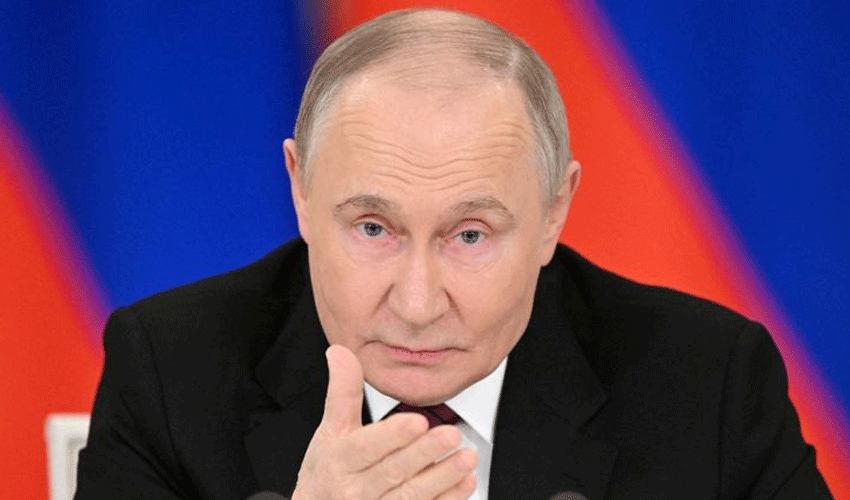
Russian President Vladimir Putin has rejected Western proposals to send a “reassurance force” into Ukraine immediately after any ceasefire, warning that such troops would be treated as “legitimate targets.”
His remarks followed a Paris summit where allies finalized plans for post-war security guarantees.
French President Emmanuel Macron announced that 26 countries had formally committed to deploying troops “by land, sea or air” to ensure Ukraine’s security once hostilities end. He stressed the force would not operate on the front lines or wage war against Russia but would deter “any new major aggression.”
Ukrainian President Volodymyr Zelensky hailed the Paris decisions as a “first concrete step,” saying thousands of foreign troops could eventually be deployed. However, he acknowledged it was too early to provide details.
The United States has not specified its role, though former president Donald Trump has suggested American backing would “probably” come in the form of air support.
Putin’s warning and response
Putin dismissed the initiative, saying foreign troops would be unnecessary if genuine peace was achieved. Speaking in Vladivostok, he argued: “If decisions are reached that will lead to long-term peace, then I simply don’t see the point in their presence.”
The Kremlin added that any such deployment—whether NATO or otherwise—would threaten Russia. “We are an enemy of NATO,” spokesman Dmitry Peskov told the BBC, calling Western proposals “provocative.”
Putin reiterated that he was open to dialogue with Zelensky but doubted meaningful progress could be reached, blaming Kyiv for “impossible” positions on territorial issues. He even offered to host talks in Moscow, an idea Zelensky ridiculed as evidence that Russia was not serious.
Strained diplomacy
The Paris summit followed a meeting in Alaska between Putin and Trump, which briefly raised hopes of a broader peace framework. While Peskov praised Trump’s “constructive efforts,” he accused European states of trying to prolong the war.
Meanwhile, Western leaders suspect Moscow is stalling for time while continuing to push militarily. Putin recently met Chinese President Xi Jinping and North Korean leader Kim Jong Un, signaling strengthened ties with Asian allies.
NATO chief Mark Rutte underscored that Russia has “no veto” over Western troops in Ukraine, calling it a sovereign decision. However, the US has already ruled out ground forces, while European diplomats warn that committing troops now could fuel Putin’s narrative of Western escalation.
UK Prime Minister Sir Keir Starmer said allies had made an “unbreakable pledge” to Ukraine, backed by Washington, while German Chancellor Friedrich Merz insisted the priority was first to secure a ceasefire before deploying any reassurance force.
More than three-and-a-half years into the war, Russia controls Crimea and parts of four other illegally annexed regions, though it has yet to consolidate its hold. Putin hinted at a “light at the end of the tunnel” this week but cast doubt on any imminent deal, citing Ukraine’s constitutional requirement for referendums on territorial changes and the ongoing martial law.
With both sides holding firm, hopes for an immediate ceasefire remain slim, and Western security plans face fierce resistance from Moscow.