Pakistan and the United States have successfully concluded a significant trade agreement aimed at reducing tariffs, enhancing market access, and fostering bilateral economic cooperation, officials confirmed on Thursday.
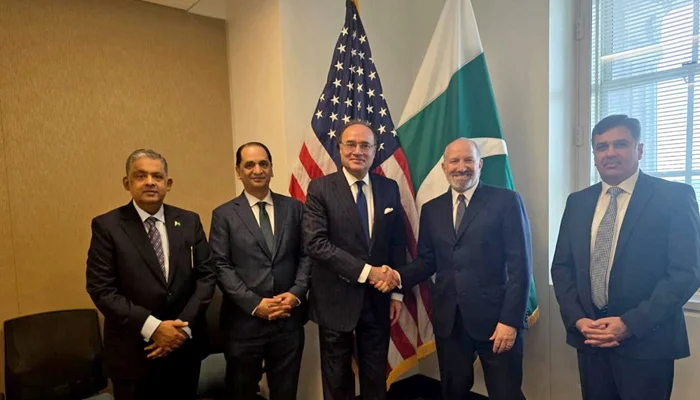
The announcement was made following a high-level meeting between Pakistan’s Finance Minister Senator Muhammad Aurangzeb and US Secretary of Commerce Howard Lutnick. The meeting was also attended by US Trade Representative Jamieson Greer.
The development was earlier confirmed by US President Donald Trump in a post on his social media platform, Truth Social, where he stated that the agreement marked the beginning of a new phase in US-Pakistan economic relations.
“We have finalized a big trade deal with Pakistan. We will explore oil reserves together with Pakistan. So much oil will be extracted that we may even be able to sell it to India,” Trump said.
According to Pakistan’s Ministry of Finance, the agreement will not only reduce mutual tariffs but also encourage investment and cooperation in key sectors including energy, minerals, information technology, and cryptocurrency. The ministry termed the development as a strategic move to deepen economic ties between the two countries.
Joint oil exploration in the pipeline
A key highlight of the agreement is a commitment to jointly explore Pakistan’s untapped oil reserves. Trump said the United States is in the process of selecting an international oil company to lead the exploration project, promising full transparency and mutual trust in the initiative.
“We are in the process of choosing the oil company that will lead this partnership. Complete transparency and mutual trust will be ensured,” he said.
Although specific technical and legal details of the oil exploration partnership were not immediately made public, both countries have indicated that the initiative will be executed through a formal framework ensuring environmental and operational compliance.
‘Mutual benefit and equal footing’
The agreement, according to observers, reflects a shift in US trade policy under Trump’s leadership, focusing on reciprocal market access and fairness in global trade.
“Other countries are making offers for tariff reduction. All of this will help reduce our trade deficit in a very major way,” Trump noted, adding that a full report on all ongoing trade deals would be shared “at the appropriate time.”
The president reiterated his administration’s position that countries seeking access to the American market must engage on “equal footing.” He added that South Korea, the EU, and several Asian countries were also in active discussions with the US over similar agreements.
Global context: pressure on trading partners
The US has already imposed or announced plans to increase tariffs on several major economies. Notably, Trump confirmed a 25% tariff on Indian imports starting August 1, citing “the highest tariffs in the world” and “non-monetary trade barriers” by New Delhi. A separate deadline of August 12 has been set for China to conclude its trade deal with the US or face steeper tariffs.
The Trump administration claims to have either finalized or initiated trade deals with a host of countries including the United Kingdom, Vietnam, Indonesia, the Philippines, Japan, and the European Union. However, White House officials admit that many of these agreements are still under negotiation and yet to be fully ratified.
Positive momentum for Pakistan’s economy
In Islamabad, the trade deal is being seen as a major diplomatic and economic win. Officials said that the reduction of US tariffs on Pakistani products would open new opportunities for Pakistani exporters and could significantly boost foreign investment inflows.
The Ministry of Finance stated that the agreement reflects a “shared commitment to strengthening economic engagement and promoting mutual prosperity.”
The new arrangement is expected to streamline bilateral trade operations, expand investment opportunities, and deepen collaboration in emerging sectors.