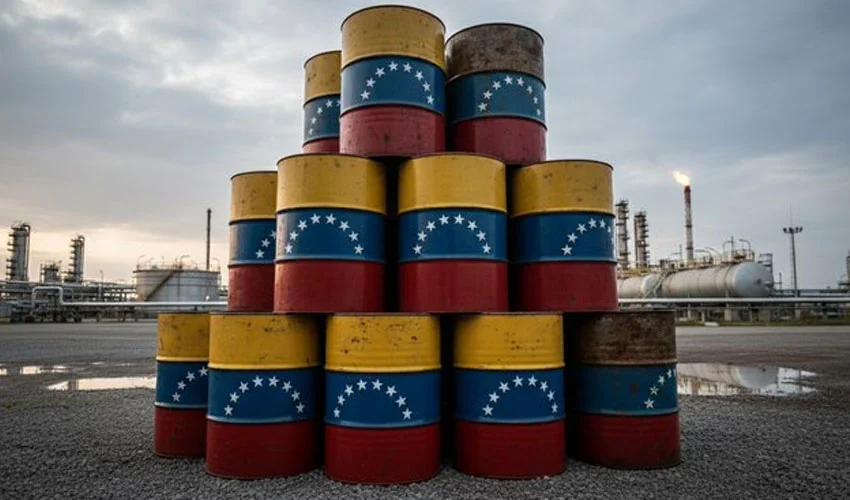
The United States announced it will control Venezuelan oil sales indefinitely, including how proceeds are used, as President Donald Trump’s administration consolidates authority over the South American country after abducting its leader, Nicolás Maduro.
The US Department of Energy said on Wednesday it had “begun marketing” Venezuelan oil on global markets. All proceeds will first be held in US-controlled accounts at internationally recognized banks, and disbursed for the benefit of both American and Venezuelan citizens at Washington’s discretion.
“These oil sales begin immediately with the anticipated sale of approximately 30–50 million barrels and will continue indefinitely,” the department added.
Trump outlines plans for oil proceeds
President Trump weighed in on how Venezuela’s funds might be used, suggesting that the country would purchase only American-made products with the proceeds.
“These purchases will include American agricultural products, medicines, medical devices, and equipment to improve Venezuela’s electric grid and energy facilities,” Trump said on his platform, Truth Social.
Operation follows Maduro’s abduction
The announcement comes days after US forces abducted Maduro, an action widely viewed by legal experts as a violation of international law. The Trump administration has said it plans to manage Venezuela and its oil reserves directly, claiming Maduro’s removal is justified after drug trafficking charges in New York.
Months of pressure preceded the raid, including a partial naval blockade, and the seizure of several vessels alleged to have transported oil in violation of US sanctions. On Wednesday, US special forces seized two Venezuela-linked vessels, including a Russian-flagged ship in the North Atlantic.
Political reactions in US
Reporting from Washington, DC, Al Jazeera’s Alan Fisher noted that most Republicans support Trump’s actions, while Democrats raised concerns about the operation’s duration, costs, and potential deployment of US forces in Venezuela.
Senator Elizabeth Warren described the administration briefing on Wednesday as “worse than imagined,” highlighting worries over the legality and broader consequences of the US plan.
Three-phased US plan for Venezuela
US Secretary of State Marco Rubio outlined a three-phase plan:
Control of oil proceeds, ensuring funds benefit Venezuelans rather than corrupt regimes.
Market access and reconciliation, allowing US and international companies into Venezuela while facilitating the release or amnesty of opposition figures.
Transition, paving the way for a new governance framework.
Energy analyst Gregory Brew said the plan hints at a return to a pre-1970s concessionary system, where Western firms manage production and retain most profits while the state technically owns the oil.
A group of United Nations experts warned that US statements about controlling Venezuela and exploiting its oil reserves could violate international law, infringing on the right to self-determination and sovereignty over natural resources—central principles of human rights law.