A forum bringing together mayors and mayoral representatives from 10 countries opened on Wednesday in Nanjing, the capital of east China’s economic powerhouse province of Jiangsu.
Themed “Flowing Rivers, Converging Future,” the Global Mayors Dialogue in Nanjing focuses on sharing urban governance experience and exploring future trends in urban development, offering insights to advance sustainable development among global waterfront cities.
Delegates from countries including Brunei, Egypt, Germany, Malaysia and China are set to engage in a series of dialogues on detailed topics such as cultural heritage protection, green ecological development and smart-city construction.
During the three-day event, they are also scheduled to visit campuses, scenic areas along the Yangtze River, and historic and cultural sites to learn about Nanjing’s experience in ecological protection, urban renewal, culture and modern development.
After touring Nanjing’s city wall, which has a history of over 600 years, Gan Tian Loo, chairman of the working committee for the historic urban area of Malaysia’s Malacca, expressed his admiration for the wisdom of ancient China.
“Nanjing boasts a rich historical and cultural heritage, alongside a vibrant modern cultural and artistic vibe, making it an increasingly attractive destination for Malaysian youth,” Gan said. He added that he looks forward to strengthening cooperation on tourism, the economy, trade and education between Malacca and Nanjing.
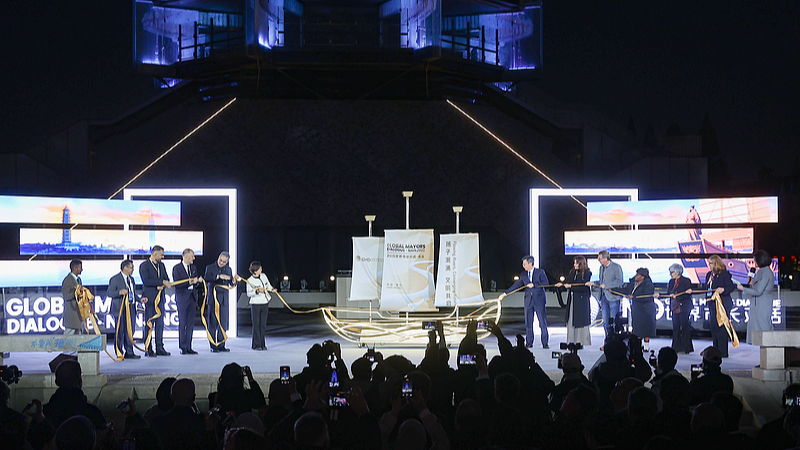
The opening ceremony of the Global Mayors Dialogue in Nanjing, east China’s Jiangsu Province, November 19, 2025. /VCG
Li Zhongjun, acting mayor of Nanjing, said the dialogue aims to share Chinese practices to address development challenges in urban governance. He noted that the city will also enhance its exchange with other cities, and strengthen sci-tech, economic and trade cooperation.
China’s approach to urban governance is undergoing a profound transformation, moving from the “build fast, build big” ethos to a more refined, delicate craft. The new approach, often called “needlework-style” renewal, puts the focus on people. Instead of clearing swathes of city blocks for new construction, mayors are optimizing existing neighborhoods with targeted improvements by upgrading services, carrying out building repairs and stitching together streets and public spaces so that daily life works better.
For example, Shanghai, the largest city in east China, is aiming to preserve its character by protecting and revitalizing its hallmark lilongs – dense lane-house neighborhoods that carry the city’s social memory. Guided by an urban renewal ordinance, Shanghai prioritizes “repair, retain, reuse.” Two tracks are common. In wider old-lilong areas, the city steps in to fix structural hazards and basic living conditions first. In historic districts, it pursues micro-renewal: careful facade repairs, roof and drainage upgrades, better fire safety, public-space infill and friendlier ground-floor interfaces.
Crucially, Shanghai manages commercial encroachment so daily life isn’t squeezed out by destination retail. The aim is a balanced street: small businesses that residents actually use, alongside cultural and community functions. Places like Yuyuan Road and the Sinan area show what this looks like. Renewal is not just repainting walls; it’s making streets walkable and sociable again with safer crossings, pocket gardens at corners, small seating areas and micro-landscapes at key nodes. The feel of the street shifts: it becomes easy to stroll, sit and linger.