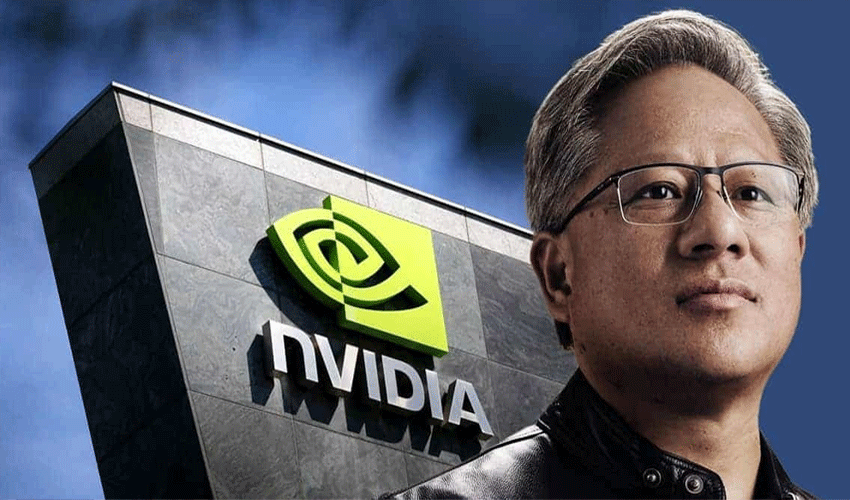
As Nvidia’s market capitalization soars past $5.12 trillion, the chipmaker has officially become the world’s first $5 trillion company.
But beneath CEO Jensen Huang’s grand narrative about foresight and innovation lies a more complex—and arguably luckier—story.
It wasn’t long ago that Nvidia made headlines for becoming the world’s most valuable company at $3.3 trillion. Then it crossed $4 trillion, and now, just months later, it’s at $5 trillion.
The company’s astonishing growth mirrors the explosive rise of artificial intelligence and the increasing demand for GPUs that power it. Still, many market analysts are beginning to wonder whether this momentum reflects a genuine technological transformation or an AI-driven market bubble waiting to burst.
Either way, Nvidia sits at the center of it all—dominating both the hardware and software ecosystems that define the modern AI landscape.
Huang’s “accelerated computing” vision
At the recent GTC event, Huang celebrated the company’s success with a keynote that framed Nvidia’s journey as one of pure vision and foresight. He described how the firm anticipated the end of Dennard scaling—a principle related to chip power efficiency—and pivoted early toward “accelerated computing.”
“We made this observation a long time ago, and for 30 years we’ve been advancing this form of computing,” Huang said, referring to Nvidia’s creation of the GPU and its CUDA programming model.

While his narrative fits neatly with Nvidia’s current dominance, some long-time industry observers remain skeptical. The story, they argue, sounds too polished, glossing over the company’s early years of trial and error.
Nvidia’s real early story
For much of its history, Nvidia was a graphics company, building GPUs for gaming and visual applications—not for artificial intelligence.
In the 2000s, Nvidia explored various experimental uses for its chips: video processing, physics simulations, protein folding, and even mineral prospecting. Most of these ventures failed to gain traction.
It wasn’t until around 2012 that Nvidia began to even mention “AI” as a potential GPU use case—and even then, it was one among many under the broad umbrella of “GPGPU” or general-purpose GPU computing.
So, while Nvidia indeed pioneered GPU computing, the idea that it predicted today’s AI explosion—with transformer models and large-scale machine learning—appears to be revisionist history at best.
What’s undeniable, however, is that Nvidia’s commitment to GPUs and its decision to build a robust developer ecosystem around CUDA gave it a massive edge when AI took off.
When deep learning models began to dominate research around 2016, Nvidia was perfectly positioned—not because it foresaw the future, but because it had already built the tools researchers needed.
That combination of engineering excellence, aggressive investment, and perhaps a healthy dose of luck, helped turn Nvidia into the undisputed powerhouse it is today.
What Nvidia’s rise means for future of AI
Nvidia’s journey offers a compelling lesson: success in technology often lies at the intersection of foresight, flexibility, and fortune.
The company’s GPUs have become indispensable to everything from ChatGPT to autonomous vehicles, yet its ability to maintain dominance will depend on whether it can continue adapting as AI evolves.
If the current AI boom turns out to be a bubble, Nvidia could face sharp corrections. But if AI continues to grow as an enduring global technology shift, Nvidia’s $5 trillion moment may just be the beginning.