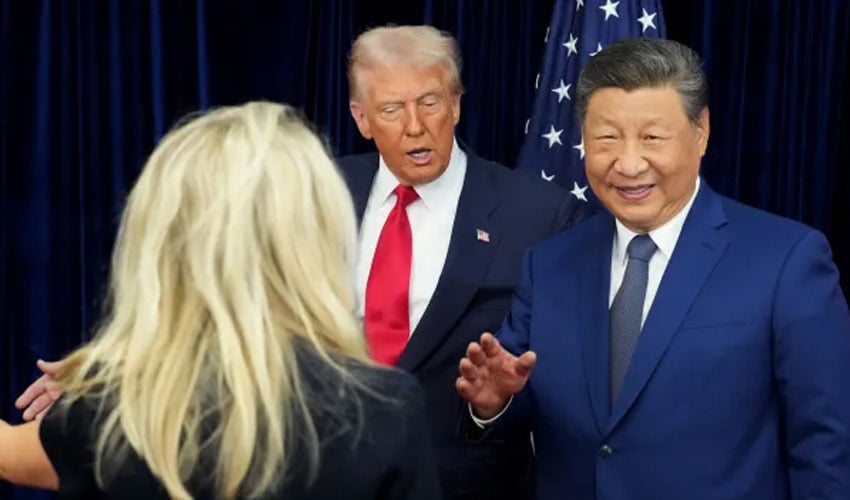
US President Donald Trump and Chinese President Xi Jinping have kicked off high-stakes talks in South Korea, aiming to resolve lingering trade tensions between the world’s two largest economies.
The summit in Busan also highlights potential collaborations on energy, AI, and infrastructure projects.
The leaders opened the summit with friendly yet strategic comments. Trump called Xi a “tough negotiator” while praising him as a “great leader of a great country.” He added, “I think we’re going to have a fantastic relationship for a long period of time, and it’s an honor to have you with us.”

Xi responded warmly, saying, “It feels very warm to see you again,” while noting that occasional frictions between the US and China are normal for the world’s largest economies. He emphasized that China’s development “goes hand in hand” with Trump’s vision to Make America Great Again and expressed readiness to “build a solid foundation for US-China relations.”
Xi highlights global diplomacy
Xi also praised Trump’s diplomatic efforts, including the Gaza ceasefire and the Cambodia-Thailand peace accord. “China and the US can jointly shoulder our responsibility as major countries and work together to accomplish great and concrete things for the good of our two countries and the whole world,” he said.
The Chinese leader pointed to “encouraging progress” already made by US-China trade teams, signaling optimism for productive discussions.
Trump calls Xi a ‘tough negotiator’
During a handshake photo opportunity, Trump acknowledged Xi’s negotiation skills, stating, “He’s a very tough negotiator,” while expressing confidence in a successful meeting. When asked about a potential trade deal, Trump replied cautiously: “Could be.”
Separately, US Commerce Secretary Howard Lutnick confirmed that $200 billion from South Korea will fund projects including an 800-mile Alaska natural gas pipeline, energy infrastructure, and AI initiatives. This agreement follows a July deal in which Seoul pledged $350 billion in investments to the US in exchange for lower tariffs, with $150 billion allocated to support US shipbuilding operations.
The Busan summit marks a critical moment in US-China relations. Beyond trade, the discussions may influence global markets, energy projects, and technological collaboration. Observers will closely watch whether this meeting leads to a breakthrough in tariffs and bilateral agreements.