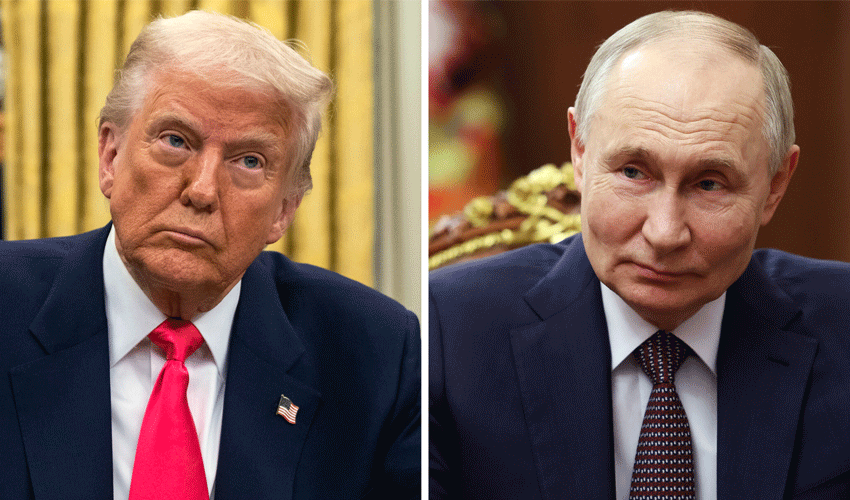
Plans for a Trump-Putin summit in Budapest have been paused after renewed friction in Ukraine peace negotiations, with both sides failing to agree on terms for a ceasefire.
The U.S. and European allies now warn that Moscow’s hardline stance could derail hopes for progress.
The White House confirmed on Tuesday that President Donald Trump currently has “no plans” to meet Russian President Vladimir Putin after diplomatic efforts to end the war in Ukraine faced a fresh impasse.
Secretary of State Marco Rubio and Russian Foreign Minister Sergei Lavrov held what officials described as a “productive call,” but both sides opted against proceeding with an in-person meeting in Budapest.
Trump had earlier announced plans for a meeting in Hungary to push for a ceasefire, but Russia’s continued territorial demands have complicated the process.
Moscow Refuses to Ease Demands
According to U.S. officials, Russia recently sent a confidential “non-paper” document reaffirming its insistence on full control of the eastern Donbas region — a demand Washington views as unacceptable.
The document effectively rejected Trump’s proposal for a ceasefire based on current frontlines. Russia already holds all of Luhansk and about 75% of Donetsk, the two provinces that make up Donbas.
Kremlin spokesman Dmitry Peskov said “serious preparation” was still needed for any future summit, adding that “neither President Trump nor President Putin gave exact dates.”
European allies urge firm US stance
European leaders urged the U.S. to maintain pressure on Moscow, warning against making concessions. Britain, France, Germany, and the EU jointly reiterated support for an “immediate ceasefire” based on existing battle lines.
A Western diplomat said the decision to postpone the planned Lavrov-Rubio meeting was a sign that Washington will not move forward without tangible progress. “The Russians wanted too much, and it became clear there was no deal for Trump in Budapest,” the diplomat added.
NATO Secretary General Mark Rutte is also in Washington this week for talks with Trump, with European officials hoping to coordinate positions on the next phase of negotiations.
Concerns over Trump’s diplomatic strategy
Trump’s direct involvement in Ukraine diplomacy has drawn mixed reactions in Europe. After a tense meeting with Ukrainian President Volodymyr Zelenskiy last week, Trump publicly endorsed Kyiv’s call for a ceasefire along the current lines of control — a stance welcomed by Ukraine’s allies.
However, many in Europe remain concerned that Trump may pursue another high-profile meeting with Putin without securing meaningful concessions from Moscow.
Budapest as controversial venue
The choice of Hungary for the next summit also sparked debate within the European Union, given Prime Minister Viktor Orban’s close ties to Moscow. Any potential visit would force Putin to fly through EU airspace — a move Poland said it might block, threatening to intercept the Russian leader’s plane.
Bulgaria, however, has indicated it would permit Putin’s passage.
Despite the pause, officials in both Washington and Moscow insist the door remains open for future talks. Kirill Dmitriev, a Kremlin envoy, wrote that “preparations continue” for a Trump-Putin meeting.
For now, the diplomatic deadlock underscores how far apart the two sides remain on fundamental issues — and how uncertain any path to peace still is.