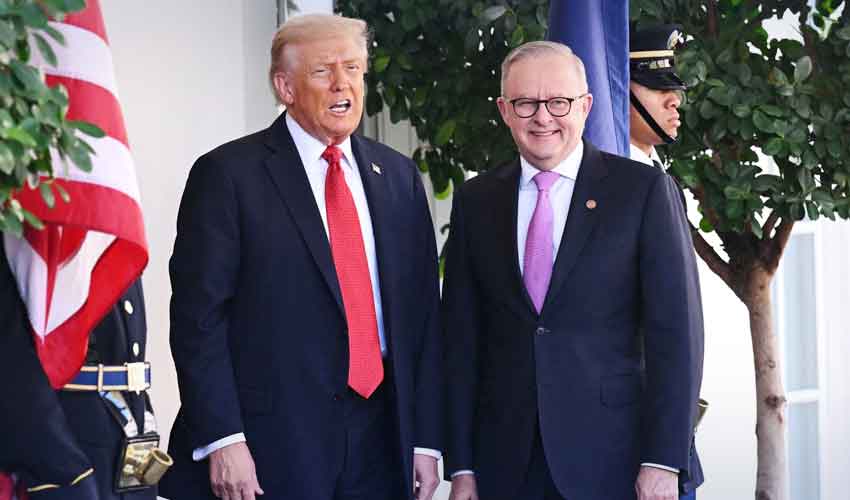
In a major step to secure critical mineral supplies, US President Donald Trump and Australian Prime Minister Anthony Albanese signed an $8.5 billion rare earths and critical minerals agreement at the White House on Monday.
The deal, negotiated over several months, comes as both countries move to reduce reliance on China, which dominates the global rare earth market.
US, Australia finalise rare earths, minerals partnership
President Trump said the agreement had been “negotiated over four or five months,” emphasizing its importance for economic and defense stability. Prime Minister Albanese described the pact as an “$8.5 billion pipeline ready to go”, adding that both nations would contribute $1 billion each over the next six months to fund joint projects related to mining and processing.
While full details were not immediately disclosed, Albanese confirmed that part of the deal focuses on mineral processing and production, with an aim to build long-term resilience in global supply chains.
The US has been seeking new sources of rare earths and critical minerals—essential for products like electric vehicles, aircraft engines, and military radars—as China tightens export controls on the materials.
Context: Countering China’s global supply dominance
According to the US Geological Survey, China holds the world’s largest rare earth reserves, but Australia also possesses substantial deposits. The US move to strengthen supply partnerships with Canberra is widely seen as a strategic counterbalance to Beijing’s influence.
Trump underscored the importance of this cooperation, saying that the deal reflects America’s “commitment to self-reliance in essential industries”.
AUKUS agreement and defense cooperation
Alongside the minerals agreement, the leaders also discussed the A$368 billion (US$239.46 billion) AUKUS defense pact, originally signed in 2023 under then-President Joe Biden. Under the deal, Australia will buy US nuclear-powered submarines in 2032, later developing a new submarine class jointly with Britain.
US Navy Secretary John Phelan said both countries are working “very closely to improve the AUKUS framework and clarify ambiguities” in the prior agreement. President Trump responded, “There shouldn’t be any more clarifications—we’re going full steam ahead, building.”
Australian officials remain confident in the pact’s progress. Defense Minister Richard Marles said last week that the review process is nearing completion and that all parties are “aligned and moving forward.”
Australia’s financial and strategic contributions
Ahead of the meeting, Australian officials highlighted that Canberra is “paying its way” under AUKUS, contributing $2 billion this year to increase submarine production rates at US shipyards.
Australia will also begin maintaining US Virginia-class submarines at its Indian Ocean base in 2027, deepening defense integration.
The 10-month delay in the official White House meeting since Trump took office had reportedly caused some concern in Canberra, though the successful summit eased those anxieties.
Economic ties and China balancing
Australia remains one of the United States’ key allies and among the lowest-tariff trading partners. However, its largest export market is China, with iron ore and coal underpinning much of its budget.
Despite the economic reliance, Prime Minister Albanese said Australia is diversifying exports following China’s $20 billion boycott of Australian agriculture and coal between 2020 and 2023.
Australia has also expressed willingness to sell shares in its strategic reserve of critical minerals to allies, including Britain and the US, in an effort to reduce global dependency on Chinese resources.
Trump on trade, China, global affairs
During his media interactions, President Trump reaffirmed his economic and foreign policy stances:
- “We want China to buy our soybeans,” he said, adding that he plans to visit China in early 2026.
- He warned that if China refuses fair trade, it will face tariffs of up to 155%.
- On Middle East tensions, Trump said the US is “trying to maintain a ceasefire in Gaza” and confirmed that the Hamas issue will be resolved soon, emphasizing he would not send US troops to Gaza.
- On Ukraine, he stated, “Ukraine can still win, but I don’t think they will,” while reiterating that he uses tariffs as tools to advance American interests.
- Trump praised the US military as “the best in the world,” claiming he had stopped eight wars in eight months through diplomacy and trade.
Leaders emphasise strong bilateral relations
At the close of the summit, both leaders expressed optimism about the US-Australia alliance. President Trump called Australia “a long-term ally and a great friend,” while Albanese described the meeting as “cooperative, professional, and hopefully warm.”
“It’s an honour to meet President Trump at the White House,” Albanese said. “Our defense cooperation with the United States remains a cornerstone of Australia’s national security.”