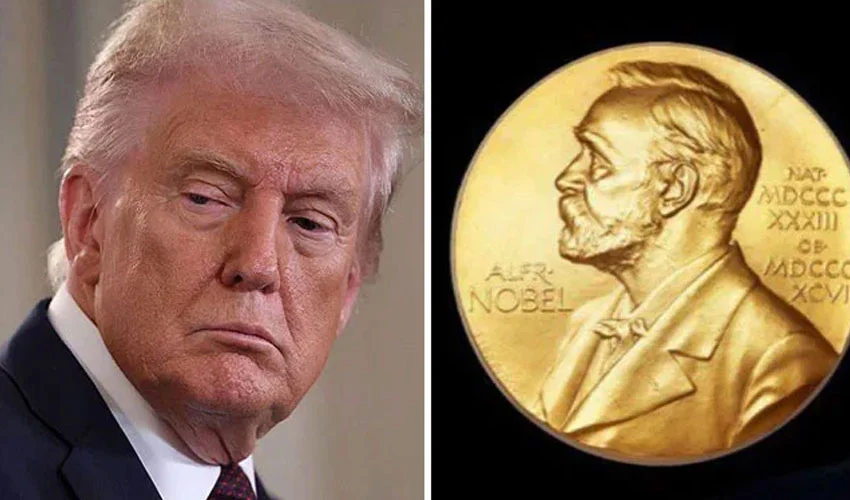
The Norwegian Nobel Committee has defended its decision to exclude U.S. President Donald Trump from the 2025 Nobel Peace Prize, saying the award is given solely on merit — not under political or media pressure.
In an official statement, the head of the Norwegian Nobel Committee said the Peace Prize selection process remains independent and guided by Alfred Nobel’s original principles. “Our decisions are based on merit, not campaigns or public appeals,” the committee chair clarified.
According to reports, nominations for the 2025 Nobel Peace Prize closed on January 31, just days after Trump’s January 20 inauguration. This timeline meant that his latest peace efforts — including the Israel-Hamas ceasefire agreement — were not considered in this year’s deliberations.
Trump’s campaign for prize backfires
Analysts say Trump’s public campaign for the Nobel Prize may have worked against him.
“The committee wants to protect its independence from political influence,” said Theo Zeno, a researcher at the Henry Jackson Society. “Trump’s open lobbying likely reinforced the perception that he was trying to pressure the process.”

Experts further note that the Nobel Committee rarely revises its decision based on last-minute diplomatic developments or new agreements.
Machado named 2025 nobel peace prize laureate
This year’s Nobel Peace Prize went to María Corina Machado, a Venezuelan opposition leader recognized for her peaceful struggle against authoritarianism and her efforts to promote democracy and human rights in Venezuela.
Observers say awarding Machado the prize signals global support for democratic movements and a rejection of populist or strongman politics.
For Trump, who has long sought global recognition for his diplomatic initiatives, this decision marks a symbolic setback.
Political analyst Matthew Mukhefi Ashton of Nottingham Trent University described it as “a calculated move” by the committee to balance global sentiment. “By honoring Machado, the committee simultaneously appeals to both Trump’s supporters and critics,” he explained.
The Nobel Committee’s head, Jürgen Watane-Friedens, emphasized that the decision aligns with “Alfred Nobel’s wishes and the true standards of peace.”
Trump’s fascination with the Nobel Peace Prize dates back to 2009, when his political rival Barack Obama received the honor shortly after taking office — a decision Trump later criticized as “elitist and unfair.”
This year’s rejection, experts say, continues that rift. However, some analysts believe that if Trump’s peace initiatives — particularly in the Middle East — prove durable, he may have another opportunity for the 2026 Nobel Peace Prize.