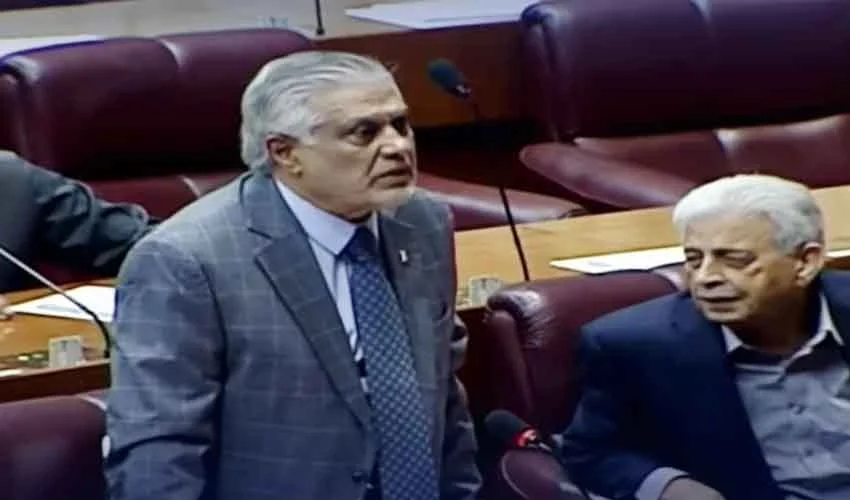
The 20 points that US President Donald Trump announced as part of his Gaza plan this week was not in line with the draft proposed by a group of Muslim-majority countries, Deputy Prime Minister and Foreign Minister Ishaq Dar said on Friday.
Changes were made in the plan, Dar told lawmakers during a briefing in the National Assembly.
Addressing the House, he emphasized unity between the Pakistan Peoples Party (PPP) and Pakistan Muslim League-Nawaz (PML-N), expressed gratitude for the PPP’s return to the assembly, and shed light on Pakistan’s diplomatic engagements, including the Palestine crisis, Kashmir dispute, and negotiations with world powers.
Political reconciliation and parliamentary unity
Dar stressed that Pakistan’s political disputes are manageable, stating: “The issues are not such that they cannot be resolved.” He noted that both PPP and PML-N possess leadership capable of navigating challenges.
He expressed appreciation for PPP’s allies returning to the House after a brief absence, underlining that issues with them will soon be addressed. Calling for balance in parliamentary conduct, he urged the opposition not to establish new traditions, adding: “I listen to them, they should also listen to me.”
Pakistan at UN General Assembly
The foreign minister recalled the prime minister’s active participation at the UN General Assembly session held from September 23 to 27.
Dar highlighted that Prime Minister Shehbaz Sharif’s address was the most watched speech of the session, where Pakistan raised critical global issues including Palestine, Kashmir, and the Indus Waters Treaty. He noted that Israel’s actions were strongly condemned and its name crossed out in protest.
Humanitarian crisis in Gaza and engagement with Trump
Shifting focus to Gaza, Dar described it as having “become a graveyard,” with people dying of hunger. He revealed that Israel had planned to seize the West Bank, making it vital for Pakistan and allied Muslim nations to engage US President Donald Trump.
He confirmed that Saudi Arabia, Jordan, Qatar, Egypt, UAE, Turkiye, and Indonesia stood with Pakistan on Palestine.
During the meeting with Trump, Dar said:
- Trump urged eight Muslim foreign ministers to meet his team, promising to seek a solution within 48–72 hours.
- Trump confirmed that the US would also meet Israeli Prime Minister Netanyahu.
“We are trying to stop all this, and no one has a personal agenda in this matter,” he remarked. Dar explained that a 20-point US proposal emerged from these talks the next day and the eight countries decided to consult among themselves before responding.
However, Pakistan, along with seven other countries, drafted a joint statement that prioritized a peaceful settlement and rejected occupation of the West Bank.
Draft proposals and joint statement
Dar elaborated that negotiations continued late into the night. At 1am, a final joint statement was prepared by the eight countries. He stressed that Pakistan’s stance remained consistent: a peaceful solution is its policy and that the West Bank must not be occupied.
“In our talks with the Saudi foreign minister, we agreed on most key points but highlighted areas that still required further engagement,” he added.
He clarified that while Trump’s proposal contained 20 points, “those were not ours” and that they had been changed. Pakistan and its allies made necessary amendments and issued their own version, endorsed by the PM through an official tweet.
“There were two options: either we continue, which would benefit Israel, or we issue our own statement. We decided to release a joint statement. The prime minister tweeted in response to Trump’s statement, making it clear that Pakistan’s stance was based on the eight countries’ joint position. Had we chosen to remain silent, it would have been the easier path, but we took responsibility,” he explained.
Palestine, UN Security Council, Pakistan’s responsibility
Dar underlined that for the first time in years, an individual resolution was passed in the UN Security Council on the issue.
He insisted that Pakistan has no diplomatic contacts or relations with Israel, and reaffirmed the policy set by Quaid-e-Azam Muhammad Ali Jinnah.
He also disclosed that 45 ships in a flotilla were seized, with around 22 detained. Among those affected, Pakistan’s former senator Mushtaq Ahmed was confirmed to be on board. Pakistan, through a third European country, has been seeking his safe release.
“Unfortunately, they told us that they do not operate on weekends, but our engagement continues, and our efforts remain focused on bringing Pakistanis back safely,” Dar added.
International support and accountability
According to Dar, the Palestinian Authority welcomed Pakistan’s diplomatic role. He emphasized Pakistan’s stance on holding Israel accountable for its aggression, noting that “no one has a personal agenda on this matter.”
Pakistan’s role with allies and strategic partners
Dar outlined other key foreign policy developments:
- Discussions with Trump also covered Pak-US trade, minerals, and IT cooperation.
- Pakistan reaffirmed China as its strategic partner, recalling joint defense projects like the JF-17 fighter jet.
- A defense agreement with Saudi Arabia was finalized, ensuring that an attack on one nation would be considered an attack on the other. This was first initiated during the PDM government.
Dar described this as a historic responsibility, noting: “Allah has given us the responsibility of being guardians of the Two Holy Mosques.” He added that several Arab and non-Arab countries are also interested in this pact.
Pakistan’s future role
Looking ahead, Dar expressed confidence that Pakistan will play a leadership role in the Muslim world. “Pakistan will lead all Islamic countries one day. It is our rightful place to be among the G-20 nations,” he declared.