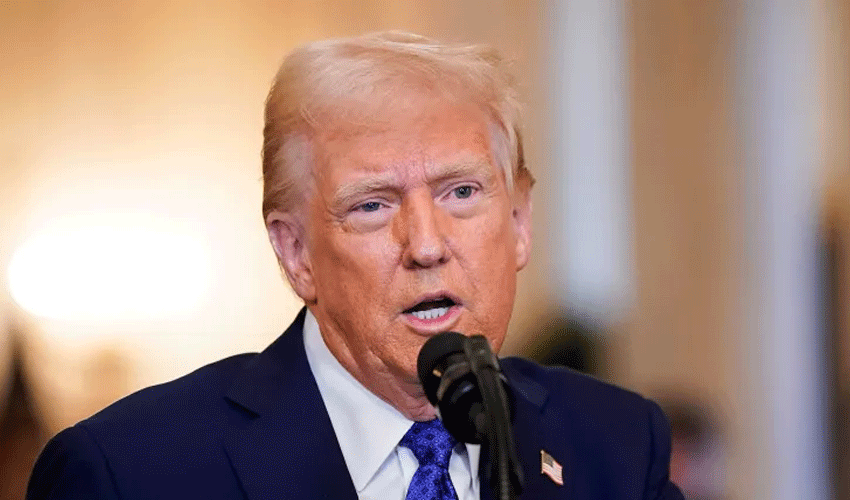
US President Donald Trump has announced what he described as a “massive” trade deal with Japan, which includes slashing tariffs on Japanese automobile exports and boosting US access to key sectors such as agriculture and energy.
In a statement shared on his social media platform, Truth Social, Trump said the deal — which he called “perhaps the largest Deal ever made” — would see Japan invest $550 billion into the United States under a new economic arrangement. He claimed the US would receive 90 per cent of the profits from the Japanese investment.
“We just completed a massive Deal with Japan,” Trump wrote. “There has never been anything like it.”
Under the agreement, Japanese exports to the US will now be subject to a 15 per cent tariff — a reduction from the earlier threat of a 25 per cent duty. The US will, in turn, gain greater access to Japan’s automobile market, as well as exports of rice, agricultural goods, and liquified natural gas (LNG).
Trump told members of Congress during a reception on Tuesday that a joint US-Japan venture would be launched to explore LNG resources in Alaska. “It’s a great deal for everybody,” he said. “A lot different from the deals in the past, I can tell you that.”
Japanese Prime Minister Shigeru Ishiba — whose coalition suffered a setback in recent upper house elections — responded cautiously to the announcement. Speaking to reporters on Wednesday, Ishiba said the agreement would be reviewed in detail but signalled it aligned with Japan’s national interest.
“We will carefully examine the specifics of the deal,” the Japanese premier said. “But the direction is important, and we believe engagement is in our economic interest.”
The agreement follows months of tense negotiations, during which Washington had threatened to impose steep tariffs on Japanese exports, including autos, steel, and aluminium. Japan, which had been subject to a baseline 10 per cent tariff, faced the possibility of 25 per cent duties had a deal not been reached before the August 1 deadline.
Trade analysts offered a mixed view of the development.
“Reciprocal tariffs set at 15% — down from the 25% earlier this month — is relatively good news for Japan,” said William Chou, deputy director of the Japan Chair at the Hudson Institute. “But questions remain whether Japan has carved out exemptions for Section 232 tariffs, particularly in sensitive sectors like steel and semiconductors.”
The US Treasury Secretary, Scott Bessent, praised the deal as a “historic agreement”, expressing optimism about a renewed era of bilateral ties.
“I am happy to reaffirm our commitment to deepening this longstanding alliance and building the next chapter of US-Japan cooperation as we enter a new Golden Age under President Trump,” Bessent said on X (formerly Twitter).
Japanese markets responded positively to the news, with auto stocks seeing significant gains. Mazda rose by more than 17 per cent, while Toyota, Nissan, and Honda saw increases ranging from 8.5 to 12 per cent. Japan’s benchmark Nikkei 225 index climbed nearly 3 per cent during early trading on Wednesday.
The trade announcement marks one of Trump’s most substantial economic engagements since preliminary agreements were reached with the United Kingdom, Indonesia, Vietnam, and the Philippines. It also comes after a temporary 90-day trade truce with China.
Japan, the world’s fourth-largest economy, remains the US’s fifth-largest trading partner. According to the US Census Bureau, the US imported $148.2 billion worth of Japanese goods in 2024, while Japan purchased $79.7 billion in US exports.
While the full details of the agreement have yet to be released, economists say the development signals a broader shift in how global markets interpret trade policy.
“It’s a sign of the times that markets would cheer 15 percent tariffs,” said Brian Jacobsen, chief economist at US-based Annex Wealth Management. “A year ago, that level of tariffs would be shocking. Today, we breathe a sigh of relief.”