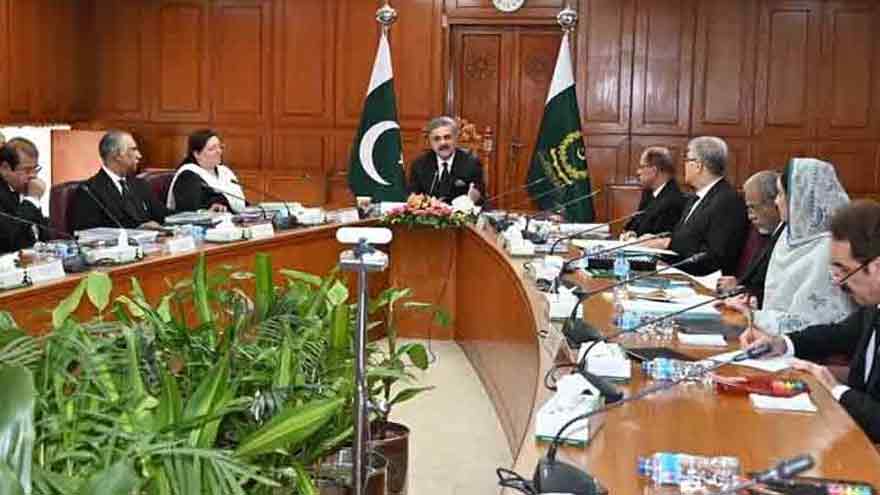
ISLAMABAD : The Supreme Judicial Council is holding a significant meeting today under the leadership of Chief Justice of Pakistan, Justice Yahya Afridi.
Supreme Court’s senior-most judge Justice Mansoor Ali Shah and Justice Munib Akhtar will attend the meeting in their capacity as Council members. Lahore High Court Chief Justice Aalia Neelum and Sindh High Court Chief Justice Junaid Ghaffar will also participate.
Sources said the Council is expected to conduct a comprehensive review of complaints received against members of the judiciary, along with an assessment of the existing rules and procedures. In addition, the judicial code of conduct will be discussed in light of letters written by senior judges.
This meeting is viewed as a critical step in ensuring transparency, accountability, and high standards within the judiciary. It will also evaluate the professional competence and behavior of judges.
As a constitutionally empowered body, the Supreme Judicial Council plays a vital role in addressing judicial complaints and overseeing performance to uphold the integrity of the justice system and bolster public trust.
Top judicial brass forms committee to tackle enforced disappearances
The National Judicial (Policy Making) Committee (NJPMC) established a dedicated committee to address enforced disappearances through an institutional framework.
The decision was announced during the NJPMC’s 53rd meeting, chaired by Chief Justice of Pakistan Yahya Afridi, at the Supreme Court.
The meeting, attended by chief justices of all high courts and the Additional Attorney General for Pakistan, reaffirmed the judiciary’s unwavering commitment to safeguarding constitutional rights.
The newly formed committee on enforced disappearances will evaluate concerns raised by the executive, as conveyed through the Attorney General.
The NJPMC also took measures to shield judicial officers from external pressures, directing high courts to create formal mechanisms for reporting and resolving such issues within a set timeframe.
Significant judicial reforms were approved, including the establishment of a Commercial Litigation Corridor with dedicated courts and benches, and a pilot Double-Docket Court Regime in selected districts. Other initiatives include court-annexed mediation, Model Criminal Trial Courts, and the introduction of district-level mediation and family court facilities.
To enhance judicial consistency, a committee led by Justice (retd) Rehmat Hussain Jafferi was formed to develop performance indicators, standardise training, and address service disparities.
Additionally, the NJPMC approved the creation of a Professional Excellence Index for lawyers induction, with high courts tasked to submit their proposals within 30 days.
The ethical integration of generative AI in judicial processes was discussed, with the National Judicial Automation Committee assigned to draft a guiding charter.
The NJPMC also endorsed standard operating procedures (SOPs) for virtual attendance of undertrial prisoners and police witness statements, and supported judicial training for police officers through academies, as highlighted in a presentation by IGP Punjab.
Following a request from the Additional Attorney General, the committee decided that constitutional petitions related to tax and finance will now be heard by division benches instead of single benches in high courts.