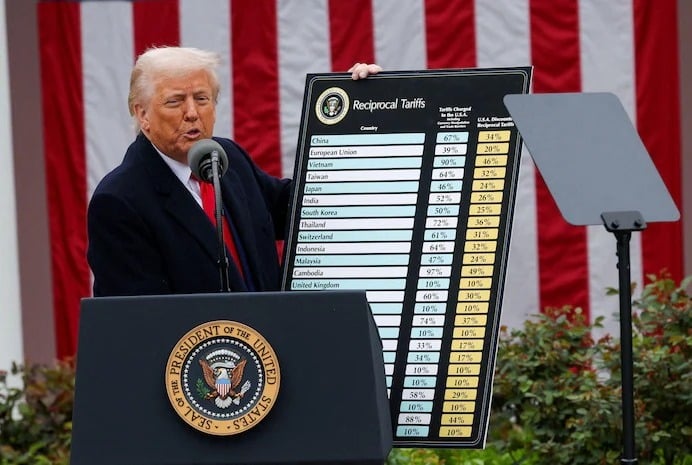
President Donald Trump has officially delayed a planned increase in tariffs on certain imports, while simultaneously notifying 14 countries — including Japan, South Korea and Thailand — of new tariff rates set to take effect from August 1.
The decision follows the expiry of a 90-day suspension period on the White House’s earlier tariff plans, which had been scheduled to lapse this week. While the higher duties were originally set for July 9, officials said they were extending the deadline to allow time for further trade discussions.
President Trump, speaking to reporters at the White House, described the new deadline as “firm, but not 100% firm,” suggesting that the administration remains open to revisions if approached by foreign governments with alternate proposals.
“This gives everyone an opportunity to come to the table,” the president said. “But we won’t wait forever.”
The delay is seen as a tactical pause, not a retreat, with the White House seeking to maintain pressure on trading partners. Alongside the announcement, Trump made public letters sent to leaders of 14 countries — among them Japan, South Korea, Bangladesh, Indonesia and South Africa — informing them of new import levies, some as high as 40 per cent.
The list includes:
40% tariff on goods from Myanmar and Laos
36% on Thailand and Cambodia
35% on Serbia and Bangladesh
32% on Indonesia
30% on South Africa
25% on Malaysia and Tunisia
The letters stated that the proposed tariff rates may be adjusted “upward or downward” depending on bilateral trade relations, leaving room for continued negotiation.
While Washington has framed the tariffs as a measure to protect American industries and address what it calls “unfair” trade practices, economists warn that such moves could escalate tensions and impact global trade flows.
“The delay was expected,” said Adam Ahmad Samdin, an economist at Oxford Economics. “These kinds of deals are detailed and time-consuming. Even the UK and Vietnam, who reached agreements with the US, haven’t completed full trade deals — just frameworks.”
Markets appeared rattled by the renewed tariff threats, with key US share indexes slipping and Toyota’s US-listed shares falling by 4%. Japan, which exported over $148 billion in goods to the US last year, remains a key target in Washington’s push for revised trade terms.
Japanese Prime Minister Shigeru Ishiba expressed concern over the announcement, calling it “deeply regrettable” and stating that Tokyo would continue to seek a “mutually beneficial” agreement with Washington.
South Korea echoed similar sentiments, saying it would use the extension period to ramp up discussions. Thailand’s finance minister, meanwhile, sounded an optimistic note, expressing confidence that Bangkok could reach an agreement in line with other nations.
Investment strategist Vasu Menon of OCBC Bank said that the move may be more of a negotiating tactic than a definitive shift in trade policy. “Trump has used tariffs as leverage before. This seems to be in the same spirit,” he said.
White House press secretary Karoline Leavitt defended the move, arguing that the president’s “tough stance” was yielding results. “His phone rings off the hook from world leaders who want to make deals,” she claimed, hinting that additional letters may be issued in the coming days.
US Treasury Secretary Scott Bessent also struck an upbeat tone, saying the administration had received “a lot of new offers” from trading partners. “It’s going to be a busy couple of days,” he told CNBC.
Trump initially announced the tariff regime in April, citing national security concerns and the need to ensure “reciprocity” in trade. The announcement triggered immediate volatility in financial markets, prompting the White House to suspend the harshest measures temporarily — including a proposed 25% levy on Japanese and South Korean goods.
Despite reaching partial deals with the UK, Vietnam and China, many key issues remain unresolved. Analysts say these agreements have often resulted in higher tariffs than those in place before Trump’s return to office.
A deal with India is reportedly close, while the European Union — which has been engaged in quiet negotiations — has yet to receive a formal tariff letter. An EU spokesperson confirmed that Commission President Ursula von der Leyen had a “good exchange” with Trump recently.
Just last week, Trump warned Japan that it could face tariffs of up to 35% if a deal was not finalised by Wednesday. That threat, while not realised this week, underscores the volatility of Washington’s trade posture under the current administration.